
Department of History and Social Sciences
Choate Rosemary Hall
Wallingford, Connecticut
History 421
CONSTITUTIONAL LAW
Spring 1999 term
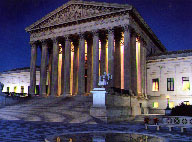
The U.S. Supreme Court Building in Washington, DC.
Hypertext Syllabus
| TABLE OF CONTENTS Goals of the Course Daily Preparation Classroom Work Written Work Texts and Course Materials Program and Workload Schedule of Meetings and Assignments Mock Court Program Mock Court Schedule Internet Database Search Engine Links |
Mr. Ned
Gallagher Free Day: Tuesday Offices: e-mail: ngallagher@choate.edu |
"The greatest dangers to liberty lurk in the
insidious encroachment by men of zeal—
well meaning but without understanding."
- Justice Louis Brandeis
History 421 course looks at how changes in the law have resulted in changes in American society, and vice versa. It studies the U.S. Supreme Court and how it has altered the basic rules of American life. We'll read an excellent history of the Court, work in mock court, and take a look at the recent state of affairs. But you'll acquire some valuable skills: the abilities to analyze sophisticated issues alone, to write about them in a coherent and concise fashion, to argue about them persuasively, and to appreciate the relationship between the law and social change. Included in these cases are questions of abortion, police brutality, capital punishment, pornography, Vietnam, and many other things that make life so interesting. In any case, should you successfully complete this course, you will win a Choate Rosemary Hall (mock, of course) Juris Doctor--your first law degree!
Assigned Reading: This is the main input of factual material, as well as various interpretations and analyses of that material. Clearly you cannot learn much in the classroom without doing the reading first. Much of our discussion in class will be conducted by the Socratic method; that is, you will complete certain assignments and will be expected to answer questions based on them. It is therefore important that you learn how to understand the material before you come to class. Looking at it another way, we will not have enough time in class to cover all the things that might appear on tests, so you had better learn them by yourself.
Course credo:
I hear, and I forget;
I see, and I remember;
I do, and I understand.
- Chinese proverb
Like athletes in training, young scholars must be sure they are properly nourished. As the reading you do for this course will be your primary "food for thought," you should pay close attention to how this nourishment is being ingested. You may find--like the decathlete weaned on junk food--that easy shortcuts will undermine your efforts when the moment of truth arrives. Assigned reading will provide focal points for daily discussion. I will try to give you pointers in advance of what to look for in the reading to enable you to get more out of it. Get into the habit of reading the syllabus carefully each night before you begin the assignment.
Lectures: This method will be used sparingly, as generally it removes the burden of active learning from the student, emphasizing a more passive role instead. Because, however, much of the information in the course will be new to you, I will provide background information when relevant to highlight material and to fill in gaps left by the reading. For the most part, however, I will "lecture" only in the sense of guiding class discussion.
Discussions: The core of the course consists of the
Socratic discussions in class, in which we will explore the reading and the topic(s) at
hand. Productive discussions are frequently contradictory and ambiguous, producing
different perspectives to chew on rather than kernels of truth to swallow whole. Asking
seemingly stupid questions may well be a way of overcoming confusion and beginning to
understand. Each person will be expected to come to his or her own understanding of the
processes involved. Such activity is not without a considerable degree of intellectual
risk, but it is hoped that in the discussions you will be willing to take such risks for
the very real intellectual gains which will accrue both to you and to the group as a
whole.
Since the main learning in the course comes from the reading
and discussions, you should attend class and be prepared to discuss the reading. If you do
neither, do not be surprised to feel you are learning little, wasting your time, or
receiving a poor or failing grade, for you are not--in any meaningful sense--taking the
course. You cannot learn much simply by writing the papers and taking the exams. Nor can
you pass the course; final grades will be based on a combination of class and written
work.
Oral Presentations: There will be regular opportunities in this course to share your ideas about the subject matter with the rest of the class on a more formal basis. While academia emphasizes the written word, most "real world" situations are centered on oral/aural interaction; hence the emphasis on developing skills in face-to-face communication. Debates, reports, role playing, and other activities will be evaluated in a manner similar to the grading of written work.
It is in your writing that you have the chance to work out your ideas most rigorously and to communicate these to others. I will give you some general notes on writing, but I also encourage students who would like to work on their writing to see me, to submit drafts of their papers for criticism in advance of their due dates, or to consider rewriting papers. In the meantime, the following are some general guidelines regarding written work in the course.
Quizzes: These serve two primary purposes. They are, of course, an insurance policy of sorts, whereby I, the teacher, can better expect you to have put in the requisite effort on assigned reading. More importantly, however, they are also a channel of feedback on how well you understand the material presented in the reading and in class. You can expect quizzes frequently, often unannounced.
Exams: These are reflective and integrative, designed to help you pull together main themes in the course. Depending on length, exams generally include objective questions, separate short definition or identification questions, and longer interpretive essays. All tests will demand not only that you know what has been studied just recently, but that you be able to connect that material in a general thematic way with what was studied earlier in the year. Each exam will be an important opportunity for me to assess your mastery of the knowledge and the skills the course seeks to develop. More importantly, an exam should be considered a worthwhile educational experience in its own right. A comprehensive final examination will be administered at the end of the term.
Make-up tests: In the event of an excused absence on the day of a scheduled exam, a mutually convenient date for a make-up test will be determined by the teacher and the student. It is the student's responsibility to reschedule and take the make-up exam within seven (7) days of the original scheduled test date. Make-up exams usually are given in essay form.
Short Papers: Papers on set topics keyed to assigned reading are designed to encourage you to work out your understanding of a given problem. As such, there are no 'right' answers, only how well you think your way through the problem as evidenced by the clarity and logic of your analysis, argumentation, and writing. All papers should include footnotes and bibliography when appropriate, and be presented in standard form, all of which is discussed in the guidelines I'll make available in class and online. Word processing is highly recommended if possible; if not, typed papers are always appreciated, though not required.
Position Papers: Each term, some students express an interest in "extra credit" work. While I generally discourage this approach--I would prefer you to concentrate on doing your best work on the scheduled quizzes, tests, and papers--I will welcome brief position papers, dealing with anything related to the course, in consideration for "brownie points." I will not put a firm grade or value on such work, which will be returned to you with my comments, but I can state that submission of position papers only can help in the determination of your final term grade.
Submission of Papers: Due dates for all major written assignments are announced in the syllabus at the outset of the term; time is allowed for working on them whenever possible and you should program your time accordingly (e.g., writing a paper before it is due if necessary to avoid conflicts with other work). Late work will be accepted, but, in the interest of fairness to all, it will be penalized one notch ("A-" to "B+") for the first 24-hour period it is overdue, two notches for the second, and so on. Late term papers will be penalized one full letter grade ("A-" to "B-") every 24 hours. Only in extreme cases will late work be accepted more than five days after it is due. School policy dictates that late work accepted after the last day of classes in the term can receive a grade of no more than 50%.
Grading and Criticism: Grading of papers and exams
will be based on the quality and thoroughness of your research (where appropriate), the
originality and coherence of your analysis and argumentation, and the clarity of your
writing. While all written work should be your own, in accord with the school expectations
regarding academic honesty, you are encouraged to discuss your work with me and with each
other if you wish. You are also encouraged to respond to my criticisms of your work and to
discuss ways in which you might improve your writing with me, including rewriting and
resubmitting papers where appropriate.
More important than the actual grade you receive is my
written commentary on your paper. I hope you will pay close attention to the comments made
on the evaluation sheet and in the body of the text; they are written in hopes of
improving both your writing and your thinking. These comments can refer to your specific
strengths and weaknesses as a historian and as a writer in ways that a simple number or
letter grade cannot.
I hope you will feel free to share with me any questions or
concerns about any particular grade; I also hope, however, that you are genuinely
concerned with what you learn in the course rather than the mark (or other such
superficial feedback) you get. For the sake of uniformity, the school has established a
guide to converting scores on a 100-point scale to grades ranging from A+ to F:
| A+ | 97-100 | B+ | 87-89 | C+ | 77-79 | D+ | 67-69 | ||||||
| A | 93-96 | B | 83-86 | C | 73-76 | D | 63-66 | F | 0-59 | ||||
| A- | 90-92 | B- | 80-82 | C- | 70-72 | D- | 60-62 |
Please immediately buy the following texts in the school store:
There should be used copies of each available. You won't need the Bartholomew text until the Mock Court section of the course. Where it says “Baum” or “Graham” in the syllabus, consult the photocopies you will be given.
By class #3, each student must have two hard copies of the U.S. Constitution: one to be brought to class every day and marked as you see fit, and the other to serve as the “unmarked” Constitution you will be allowed to use during tests. You may write your name on the second copy, but nothing else. Should any other mark be discovered during a test, you'll fail the test, and may be turned in to the deans for disciplinary action.
The Andrew Mellon Library has an admirable collection of U. S. Supreme Court Reports and articles in The New York Times on the modern cases. I'll show you how to use the Reports. You also will be able to access many of the more recent decisions on the Web (see below).
The first part of this course will be orthodox in its presentation: in general, you'll read something before each class meeting, and in class we'll discuss what you've read--what I call "Socratic discussion." You'll be expected to write short yet demanding papers, take a period test, and participate regularly in class.
There will be one period test and three reltively short papers this term. The first two papers will have a maximum length of two pages, leaving at least one-inch margins all around for reader comments.
You may want to read and take class notes in the opening weeks with an eye to these topics. Paper topics are as follows:
(1) Due at the same class when Dred Scott is being argued (except for the “lawyers,” who will have the option of a penalty-free forty-eight hour extension): Since there exist court systems that do not have the power of judicial review, why was that power inevitable in the American system? The answer is in your head if you know what judicial review means.
(2) Due at the same class when CMSPRR is being argued (again, with the “lawyers” granted the option of a penalty-free forty-eight hour extension): Did Daniel Ellsberg's purloining of the Pentagon Papers in 1971 illustrate what McCloskey meant by a “higher law” on page 7 of the text? This question is not about the publication of the Pentagon Papers, but the taking of them. Consult The New York Times Index for research. Again, though, the answer is in your head if you know what's meant by higher law.
Every effort has been made to keep the length of daily assignments manageable. Many worthwhile assignments were abbreviated or scrapped from the syllabus altogether. It's important, therefore, that you commit yourself now to keeping up with what is included among the assignments below; you'll be expected to complete the assigned homework before each class. Only rarely will the assignments in McCloskey be long in pages. But you'll find most sophisticated and occasionally difficult. Do the work diligently, concentrating very sternly and looking up elements in the Constitution. Try to get ahead in the reading, so you can have plenty of time to work on your papers.
What follows is what we'll try to cover during the term. It may be adjusted from time to time for any number of reasons. The homework for the next class is always the next assignment unless you are told differently. You'll find each entry on the schedule below contains some instructive questions and ideas you should consider in preparing for class; get into the habit reading the syllabus carefully each night as you begin your homework.
Schedule of Meetings and Assignments
1. Introduction. No assignment. We'll get to know each other in this session and discuss an overview of the course.
2. The Anglo-American Legal Tradition. Read McCloskey, pp. 1–15. Work hard at this assignment, but do not get bogged down in what you don't understand. Make sure you understand the basic underpinnings of the Anglo-American legal tradition: what is common law and how does it relate to "higher law" as described by McCloskey? Why was little expected of the Court in the early days of the United States? Do justices pay attention to public attitudes, or are they removed from the people because they serve for “good behavior”? Isn't the Supreme Court inherently undemocratic?
3. Establishing Judicial Power. Read McCloskey, pp. 16–34 and Article III of the Constitution of the United States. You will need to have two hard copies of the Constitution for this course: one for marking and a clean copy for use on period tests. What are the three ways by which we can test the Court's power? Look for those items in each of the famous cases—Marbury, Fletcher—and look up the Constitutional provision that applied in each.
4. The Federal Court System. Read Baum handout, to be distributed. Learn the organization of the system, and what the High Court and the other courts do. Learn the names of the current Justices and of the courts. Do you think the Supreme Court is a willful policy-making arm of the United States government?
5. The Marshall Court I. Read McCloskey, pp. 35–47. Learn the “facts” in McCulloch, Martin, Cohens, Gibbons. What was the Court trying to accomplish? Was it willful in doing so? What did it accomplish? Recall U.S. history: what did the Federalists stand for? Volunteers needed for Dred Scott; see #9, below. It's an early start on mock court work. Mention it in class and you and a teammate get it.
6. The Marshall Court II. Read McCloskey, pp. 47–52 and Baum, pp. 105–110. Note: this class will meet in the Andrew Mellon Library; do not be late! Learn the “facts” in Dartmouth. How did the Court create its “constituency”?
7. The Taney Court. Read McCloskey, pp. 53–59. What had Taney done in the “war on the Bank” that helped Jackson so much but worried the Court's constituency? See a U. S. history textbook if you need to. Learn the “facts” in Mayor, Cooley, Charles River, and Briscoe.
8. The Error. Read McCloskey, pp. 59–66. Dred Scott was the worst decision ever handed down by the U.S. Supreme Court. Using what you have learned about how Marshall and Taney had built the Court's prestige and power, be prepared to show why the decision was such a mistake. Briefs for Dred Scott due today. Paper due tomorrow for all but the “lawyers” in Dred Scott. Volunteers needed for the case at #12 below.
9. Mock Court I. Scott (_______ & _______) v. Sandford (_______ & _______), 19 How 393 (1857). Instructions separately. Paper on judicial review due from all but the lawyers.
10. Reconstruction. Read McCloskey, pp. 67–76. Recall the author's chronological division of his book: why do we start with Vallandigham and Millican if this section is about “the regulation of business”?
11. Due Process. Read McCloskey, pp. 76–90 and essay online. Define substantive due process in a way that you can understand. Then be sure you can trace the history of the doctrine from Hepburn to Knight. Be able to cite the Constitutional passages that apply. Briefs for CMSPRR due today. Paper due tomorrow from all but the “lawyers.”
12. Mock Court II. Chicago, Milwaukee, and St. Paul Railway (_______ & _______) v. Minnesota (_______ & _______), 134 U. S. 418 (1890). Rules as in Dred Scott. Paper on higher law due today from all but the lawyers.
13. Welfare State. Read McCloskey, 91–100. Keep substantive due process in mind. Why did the Court shift on the question of the income tax? How did Congress respond to the shift? Get the reasons for the apparent lack of consistency by the Court regarding governmental regulation of business affairs. See clue, 19.
14. Rear Guard. Read McCloskey, pp. 100–108. Note: This class will meet in the Andrew Mellon Library. Stop a moment and consider: what was the major social change that occurred during 1905–1937, and what role did the Court play in furthering it? How did the cases given here relate to that role?
15. The Big Shift. Read McCloskey, pp. 108–113, 117–120. Account for both the Court's early opposition to Franklin D. Roosevelt's policies, and its later shift. For today, as assigned, read one of the following cases in the U. S. Supreme Court Reports and be able to describe the case to the rest of the class, including the contentions of both parties and the decision of the Court. Your notes on the case must be submitted. The cases:
Schechter v. U.S. 295 U.S. 495 (1935) (__________ & __________)
Morehead v. N.Y ex rel Tipaldo 298 U.S. 587 (1936) (__________ & __________)
U. S. v. Butler 297 U.S. 1 (1936) (__________ & __________)
West Coast Hotel v. Parrish 300 U.S. 379 (1937) (__________ & __________)
NLRB v. Jones and Laughlin 301 U.S. 1 (1937) (__________ & __________)
Helvering v. Davis 301 U.S. 619 (1937) (__________ & __________)
Briefs for both sides of the Plessy, Schenck, Near, Missouri, and Smith cases are due along with assignment #16. Look ahead to the mock court schedule to see if you have one of them, and get the work done.
16. The Warren Court. Read McCloskey, 148-173. Note: the first ten case briefs are due in class today; see the schedule below. Make a list of the areas in which the Warren Court became active. Can you name a case which occurred within each of those areas? Analyze the holdings and see if you agree with them.
17. Midterm Examination. Covering all the material studied since the beginning of the term. You may bring (a) an unmarked copy of the Constitution and (b) an unmarked paperback dictionary for use during the test.
From this point in the course onward, the syllabus becomes quite complicated. Read it carefully now so that you can ask questions if you have them. Some past students in this course have made some very bad mistakes by not reading this part of the syllabus closely. Read it now and carefully.
The Approach. Case work is the best way to study the law. We'll spend the rest of the term engaged in Mock Court proceedings. On Thursday, April 15, I will help you understand the legal resources available to you in the Andrew Mellon Library and on the Internet. Then on Friday, April 23, Mock Court will convene for the first time. We will argue two cases per day (three on 55-minute class days) back-to-back. The Mock Court will hear all oral arguments for the day's cases and then spend the remaining time deliberating. As counsel before the Mock Court, you must plan your arguments to fit the time limits. Petitioner gets five minutes and may reserve up to ninety seconds of that time for rebuttal. Respondent also gets five minutes, but may only use it in one presentation. During conference, counsel may remain, but they must not be noticeable in any way or they will be thrown out of the room and penalized in grade. Note that we hear cases in the same chronological order as the Real Court. That will skew some of our results. Insofar as counsel can remind the Mock Court of the contemporary situation, it will be a good idea to do so.
THREE WARNINGS:
(1) Cases will be heard and briefs and opinions will be due the first class after Long Weekend. Deal with it.
(2) Look ahead to all your cases, so you can plan your personal workload. The schedule is not symmetrical and you may go periods without much to hand in, only to find yourself crushed for a few days. Plan now, because everyone does the same amount of work for the entire course, and so no leniency will be granted. Each of you will prepare briefs for and argue six cases, write three per curiam opinions, and write two dissenting opinions.
(3) If for any reason you will miss a class, it is your responsibility to inform me well in advance, so that I can arrange a substitute for you if it is necessary to do so. You must do all written work ahead of the day due if you will miss a written assignment by being away from class. The casework schedule is intricate and will not long endure if absences mount up. Try to schedule your trips to colleges, etc., so that they do not conflict with our work here. In any case, failure of early notification will cost you a heavy grade penalty.
Please read the following schedule carefully. There may be an error that only you will pick up. It is not an error if you find that you are doing more than one thing on a given day.
| Day/Date | Case | Counsel Assigned |
Per Curiam Assigned |
Briefs Due | Opinions Due |
| Fri., 4/23 | Plessy v. Ferguson 163 U.S. 537 (1896) I |
A v. B | L | KLDA | None |
| Schenck v. U.S. 249 U.S. 47 (1919) III |
C v. D | K | |||
| Wed., 4/28 | Near v. Minnesota 283 U.S. 697 (1931) III |
E v. F | J | FBHC | KL |
| Missouri v. Canada 305 U.S. 337 (1938) I |
G v. H | I | |||
| Smith v. Allwright 321 U.S. 649 (1944) I |
I v. J | H | |||
| Thu., 4/29 | Korematsu v. U.S. 323 U.S. 214 (1944) I |
K v. L | G | JELGKI | H |
| Morgan v. Virginia 328 U.S. 373 (1946) I |
D v. A | F | |||
| Fri., 4/30 | Colegrove v. Green 328 U.S. 549 (1946) IV |
F v. B | E | AFDH | GIJ |
| Dennis v. U.S. 341 U.S. 494 (1951) III |
H v. C | D | |||
| Mon., 5/3 | Brown v. Board of Education 347 U.S. 487 (1954) I |
J v. E | C | BJCL | DEF |
| Yates v. U.S. 354 U.S. 298 (1957) III |
L v. G | B | |||
| Gomillion v. Lightfoot 364 U.S. 339 (1960) I |
K v. I | A | |||
| Thu., 5/6 | Mapp v. Ohio 367 U.S. 643 (1961) II |
A v. F | L | EKGIHA | BC |
| Baker v. Carr 369 U.S. 186 (1962) IV |
D v. H | K | |||
| Fri., 5/7 | Engel v. Vitale 370 U.S. 421 (1962) III |
B v. J | I | JFLD | AK |
| Gideon v. Wainwright 372 U.S. 335(1963) II |
C v. L | J | |||
| Sat., 5/8 | NY Times v. Sullivan 376 U.S. 254 (1964) III |
E v. K | H | KBIC | JL |
| Griffin v. Board of Education 377 U.S. 218 (1964) I |
G v. I | F | |||
| Escobedo v. Illinois 378 U.S. 533 (1964) II |
H v. A | G | |||
| Mon., 5/10 | Griswold v. Connecticut 381 U.S. 479 (1965) III |
J v. F | E | GEAJ | FHI |
| Memoirs v. Massachusetts 383 U.S. 413 (1966) III |
L v. D | C | |||
| Wed., 5/12 | Miranda v. Arkansas 384 U.S. 436 (1966) II |
K v. B | D | HLFK | CEG |
| Chimel v. California 395 U.S. 752 (1969) II |
I v. C | B | |||
| Thu., 5/13 | Swann v. Charlotte 402 U.S. 1 (1971) I |
G v. E | A | DIBGCE | None |
| Lemon v. Kurtzman 403 U.S. 602 (1971) III |
A v. J | L | |||
| Fri., 5/14 | New York Times v. U.S. 403 U.S. 713 (1971) III |
H v. L | K | LAKJ | BD |
| U.S. v. Caldwell 408 U.S. 665 (1972) II |
F v. K | J | |||
| Mon., 5/17 | Furman v. Georgia 408 U.S. 238 (1972) II |
D v. I | H | IHGF | AJKL |
| Roe v. Wade 410 U.S. 113 (1973) III |
B v. G | I | |||
| U.S. v. Robinson 414 U.S. 218 (1973) II |
C v. E | G | |||
| Thu., 5/20 | U.S. v. Calandra 414 U.S. 338 (1974) II |
L v. A | F | EDCB | GHI |
| U.S. v. Nixon 418 U.S. 683 (1974) IV |
K v. J | E | |||
| Fri., 5/21 | Milliken v. Bradley 418 U.S. 717 (1974) I |
I v. H | D | TBA | EF |
| Gregg v. Georgia 428 U.S. 153 (1977) II |
G v. F | C | |||
| Mon., 5/24 | Regents v. Bakke 438 U.S. 265 (1978) I |
E v. D | B | None | None |
| Lynch v. Donnelly 465 U.S. 668 (1984) III |
C v. B | A | |||
| Thu., 5/27 | Super Bowl Case | TBA | TBA | None | ABCD |
Notes on the Schedule:
1) This is the key to the counsel assignments above:
| A | Ms. Braxton | E | Ms. Ernandes | I | Mr. Kovacs | ||
| B | Ms. Carter | F | Ms. Janeczko | J | Ms. Kubach | ||
| C | Mr. Chang | G | Mr. Kim | K | Ms. Pickard | ||
| D | Mr. Clair | H | Mr. Kirschmann | L | Mr. Regan |
The letters also identify the "Justice" who will write the opinion of the Court. Unlike what happens in the Real Court, our per curiam will be written by this Justice no matter how she or he voted. See the column "Opinions Due" for the date the per curiam is due. An opinion must not exceed one page in length, giving the correct citation for the case and the Court's vote. Otherwise the opinion must mimic the way the Real Court writes.
2) Citations are to "U.S. Reports," which you can translate from the L.Ed and S.C. Reports we have in our Library. Do not overlook The New York Times, which is a splendid resource on those cases after about 1960.
3) The roman numerals following the citations indicate the type of case. Key:
I = civil rights of minorities
II = rights of defendants in criminal cases
III = civil liberties
There are others we might have done--e.g., political issues, states' rights, trusts, regulatory agencies, military cases--but these are the choices.
4) Legal briefs, comprised of only one side of one sheet, must be submitted at least two class days before the case is to be argued, as per the schedule above. Be careful here: submit a copy to me and one to the opposing lawyer by classtime on the day the brief is due. You may send it as a Microsoft Word document via e-mail attachment. You'll get a corrected copy back from me the next class. You must be prepared to distribute a photocopy to each member of the class on the day your case is to be argued, so that all can read them before the oral argument. Late briefs will be severely penalized. You may have to write opinions and prepare other cases during this time, too, so plan your work carefully.
5) In addition to the assigned per curiam opinions, each student must write at least two additional opinions in a case where he or she dissents. You may not write a dissent in a case when you are assigned the per curiam. Don't wait here: if you dissent in an early case write the dissent then, because you may be trapped later on if you delay. Dissents are due the same day as the per curiam in the case. Late dissents will not be accepted.
6) Near the end of the term, the class will select the two best lawyers and I will select the best opinion writer to do the "Super Bowl case." Presuming all work is completed in good faith, the super bowlers will earn grades of "A+" or "A" for these cases and opinions. Any student may dissent for extra credit.
7) The first ten briefs are due in class #16. Thereafter, all briefs will be due before the case is to be argued; they will be returned the next class day and copies must be distributed to all in the class before oral argument.
8) Each student has six cases to prepare and argue and three per curiam and two dissenting opinions to write this term. The written work will be generally short but demanding. Grades for Mock Court work will be awarded as follows: (a) to "counsel" for research, analysis--i.e., how well arguments were tied to the Constitution, statutes, needs of the people in changing times, common sense, and whatever else is applicable--clarity, quality of written and oral work, and whether you were able to keep the Mock Court consistent with the Real Court or were able to "reverse" history; and (b) to "justices" for quality and especially clarity of writing, since millions of Americans must be able to understand what you say the law is, and analysis in deliberations and opinions. In both roles, you are to seek verisimilitude: pretend that it is the day the case was heard by the Real Court, and that you know only what was known then. You may, of course, make reasonable speculations about the future, but you may not know it.
9) Be coöperative with the others in this class. Sometimes several students will need the same volume of the Reports, so don't walk away from the reference section with a book causing a panicky search. If anyone is uncoöperative, I will take disciplinary action. Don't ever rip a page out of the Reports. One student did so some years ago; a relentless investigation uncovered the culprit, who was expelled.
10) Lawyers may help each other in the research and in understanding the cases. There are two limits: (a) no student must exploit another, and no student must allow himself to be exploited; (b) once writing has begun, all consultation must stop. If you do get help from other students, write a note that tells me about it and staple it to the brief. If you are graceful in this matter, both will be rewarded, but anything dishonest will be punished.
FindLaw's searchable database of the Supreme Court decisions since 1906 (U.S. Supreme Court Decisions: U.S. Reports 200-, 1906-). Browsable by year and U.S. Reports volume number and searchable by citation, case title and full text.
Browsing
Citation Search
Title Search
Full-Text Search
Course materials originally developed by Dr. W. Thomas
Generous Jr., CRH History Department Emeritus.
This syllabus copyright © 1999 Ned Gallagher. All rights reserved.
Last revised: 29 March 2000