![[View of Fuji]](../images/fuji.jpg)
Hokusai Katsushika,
"Mt. Fuji Between the Waves off the Coast of Kanagawa; One of 36 Views of Mt. Fuji"
Department of History, Philosophy, Religion, and Social Sciences
Choate Rosemary Hall
Wallingford, Connecticut
History 432AD
MODERN JAPAN: From Samurai to Sony
Hypertext Course Syllabus
Fall 2006 term
| TABLE OF
CONTENTS Goals of the Course Course Policies and Grading Texts and Course Materials Program and Workload Schedule of Meetings and Assignments |
Contact Information Memorial House #114, 697-2340 Johnson Athletic Center #105, 697-2418 preferred e-mail: |
"Go ni irite wa, go ni shitagae."
- Japanese proverb
The goals of this course are threefold: Modern Japan is designed (1) to provide survey knowledge of Japanese history from the late Tokugawa period through the present day; (2) to cultivate familiarity with a non-Western culture; and (3) to develop your proficiency as an historian by fostering (a) an empathic perspective and (b) the academic skills of critical reading, thoughtful analysis, systematic research, persuasive writing, careful listening, and effective oral presentation.
A summary of course policies and grading standards can be found online by clicking here.
These texts for the course--available at the school bookstore--should be purchased by all students immediately:
These texts will be supplemented by other readings, to be distributed as handouts or electronically.
Some of the readings for the course are challenging, but they have been selected carefully for the contributions they offer to understanding Japanese history and society.
A Note on Language
Some of the proper names you encounter will be referred to in the tradition of the native land. That is, Japanese names are presented with the family name first, followed by the individual's name (e.g., Mishima Yukio). Foreign words that are not proper names or have not been adapted to common use in American English (e.g., sushi, samurai) should be italicized in your papers.
This course will be orthodox in its presentation: in general, you'll read something before each class meeting, and in class we'll discuss what you've read--what I call "Socratic discussion." You'll be expected to write short yet demanding papers, take period tests and a final examination, and participate regularly in class.
The few papers you write must follow the "empirical essay" format and use the APEC method of argument. If the syllabus doesn't say something to the contrary, then the paper is to be two pages long. That means one sheet written on both sides if you handwrite, or two fronts if you type or word process. If you use notes or bibliography, they may go on a separate sheet. In fact, you may always write as many pages as you want, but the first two will be read and graded.
Every effort has been made to keep the length of daily assignments manageable. Many worthwhile assignments were abbreviated or scrapped from the syllabus altogether. It's important, therefore, that you commit yourself now to keeping up with what is included among the assignments below; you'll be expected to complete the assigned homework before each class.
Schedule of Meetings and Assignments
What follows is what we'll try to cover during the term. It may be adjusted from time to time for any number of reasons. The homework for the next class is always the next assignment unless you are told differently. You'll find each entry on the schedule below contains some instructive questions and ideas you should consider in preparing for class; get into the habit reading the syllabus carefully each night as you begin your homework.
Part I: The Roots of Tokugawa Japan, pre-history to 1868
Hokusai Katsushika,
"Mt.
Fuji Between the Waves off the Coast of Kanagawa; One of 36 Views of Mt.
Fuji"
1. Course Organization
No assignment. We'll spend the time in this class getting to know one another. The course syllabus and other course materials will be distributed. Be sure to read through the introduction to this syllabus thoroughly.
2. Land and People I: Geography.
Read Reischauer, pp. 4-12 and 16-26. At this point, don't get bogged down by the names and dates in the reading; instead focus on the general concepts. To what extent has Japanese culture been shaped by the geography of the home islands? By China's influence? Study the maps of Japan (including the one on page 6 of the Reischauer text) so that you can identify the four main islands and the locations of major cities Fukuoka, Hiroshima, Kobe, Kyoto, Nagasaki, Nagoya, Osaka, Sapporo, Tokyo (Edo), and Yokohama for a geography quiz in class #4.
3. Land and People II: Race and Nation.
Read excerpts from the Shinto creation myth and James Fallows, "The Japanese Are Different From You and Me," both to be distributed. Compare and contrast the story of the Sun Goddess with the Genesis account in the Judeo-Christian tradition or other creation myths with which you may be familiar. Note the connection between the legend of the Sun Goddess and the Japanese monarchy today. [Brownie points if you find out what the term caesaropapism means.] What are the connections between the Japanese creation myth and the modern attitudes Fallows describes in his essay? How do these attitudes differ from racism in America?
4. Religion I: Four Great Traditions.
Read "Religion I" reading packet, to be distributed. There isn't a single source that adequately treats Shinto, Taoism, Confucianism, and Buddhism for our purposes, so I've created this pastiche of excerpts which we will sort out together in class over two days. Think about how these religious traditions shape the contemporary Japanese cultural mindset. How do the elements of these traditions reflect the themes of rice culture and national/racial identity we've already discussed? Map quiz in class today.
5. Religion II: The Sound of One Hand Clapping.
Read "Religion II" reading packet, to be distributed. This assignment explores the general roots and central tenets of Buddhism in general, as well as an important and influential strain of Buddhism in Japanese culture. Zen Buddhism is a pursuit which is fundamentally intuitional rather than intellectual. Our task, then, as scholars trying to attain an academic understanding of Zen is nigh impossible, but we'll struggle with it nonetheless.
6. Religion III: Values in Modern-Day Japan.
Read Thomas Rohlen, "Spiritual Education in a Japanese Bank," to be distributed. Consider how the bushido ethic and Japanese religious and cultural traditions are employed to create certain attitudes among today's Japanese managerial elite. Why do bankers need to pursue zazen? If you can make these connections on your own, you're on the road to understanding why Japan has become so successful economically in the last forty years.
7. Feudalism.
Read "The Age of the Samurai" (to be distributed) and Reischauer, pp. 64-82. The handout is an overview of the pre-modern period which should be helpful. Don't get lost in the names and details early in the Reischauer reading, which no doubt you will find confusing; instead, pay attention to the emergence of the national system of government (especially as described on pp. 67-74). Keep track of the vocabulary of the Tokugawa "feudal" system, however: bakufu, shogun, daimyo, samurai. Those of you who are medieval history whizzes: how similar is Tokugawa Japan to the European feudalism you've studied?
8. Meanwhile, in the Middle Kingdom . . .
Read "The Emergence of Modern China" online. This short but important assignment covers the "rape of China" by the Great Powers. This may seem like a digression, but consider the impact the Chinese experience in the 1800s had on the Japanese. Understanding China's history in this period is critical in makings sense of the direction Japan chose at the outset of the Meiji Period. Again, don't be slowed down by all the details of the history; search for the major historical themes and developments. Consider the extent to which Western imperialism was responsible for the fall of the Qing dynasty as well as the domestic pressures on the traditional order.
9. Review.
Read "Answering Historical Identification Questions" and "Writing Essays on History Tests" (click to access online) before you begin studying. This is the only class we'll have this term devoted exclusively to review, so make the most of it! I'll have no prepared presentation; come to class with your questions based on everything we've studied so far. In class, you will receive a handout outlining your responsibilities for an oral report covering some significant aspect of Japanese history in the World War II and Occupation eras.
10. Period Test #1.
This exam will cover everything we've studied to date. Your responses to the handouts on oral reports are due at the beginning of class. While you are taking the exam, I will assign topics, as well as the dates to be presented. You may bring an unmarked paperback dictionary into this and all other exams in the course, but you may not share it with anyone else.
11. Isolation.
Read Reischauer, pp. 82-100 and correspondence of President Fillmore and Commodore Perry to the Emperor (in the handout). How were the newly-arrived Westerners a threat to Japanese society in 1853? Why did Japan gradually close its doors to foreigners between 1587 and 1639? What effects did this Tokugawa policy have? Who in Japanese society benefited? Who was hurt? What long-term changes did Japan undergo during Tokugawa rule? How did the self-imposed period of isolation make it possible for Commodore Perry to "open" Japan in the mid-1800s
Part II: The Rise to World Power, 1868-1945
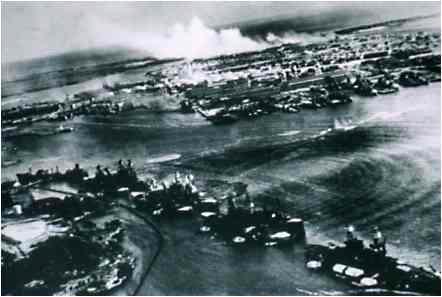
This captured Japanese photograph shows
the December 7, 1941 attack on the U.S. naval base at Pearl Harbor.
12. The Meiji Restoration
Read Reischauer, pp. 101-115. Recall the reading on China. How did the Chinese experience affect the decision to abandon the Tokugawa political/social structure? What internal conditions prompted the shift? Could the Meiji Restoration be described as a revolution? Why was the Restoration so successful, given the very conservative tenor of the Tokugawa era? What were the goals of the Meiji leadership? Why was it necessary to abandon the traditional class system (p. 103) in pursuit of those goals? Remember the notion of island culture. Keep track of the various reform movements in your notebook.
13. Republican Japan.
Read Reischauer, pp. 116-131. What were the models for the new Meiji political system? How did the role of the emperor change? What advantages and disadvantages did the parliamentary system present? Do you see evidence of growing pains? Be sure you can document the growth of Japanese imperialism, as discussed in the last few pages of the chapter.
14. Industrial Japan.
Read Reischauer, pp. 132-151. Pay attention to the parallels between the industrial development of the early twentieth century and the postwar prosperity of the past forty years. What were the zaibatsu? Do they have modern-day equivalents in Japanese society? In America? In what ways could Japan's emergence as an industrial power be seen as setting the nation on a course for Pearl Harbor?
15. Imperial Japan.
Read Reischauer, pp. 152-169. Here it's particularly important to try to understand Japan's view of the world from a Japanese perspective. Ask me in class about the "Atticus Finch theory of history." Find three distinct ways in which Japan was made to feel inferior to its Western rivals in this time period.
16. Japan at War I: Overview.
Read Reischauer, pp. 170-181. Why did Japan bomb Pearl Harbor? What connections does Fallows make between December 1941 and current attitudes between the U.S. and Japan? What was Tokyo's overall strategy in the Pacific War? Why did it ultimately fail? Keep track of the shifts in political power during the war. In class we'll begin oral reports on various aspects of World War II and Japanese society during wartime. Remember the time limits! Also, don't be trapped by the conventions of oral report delivery you learned back in Mrs. Goodheart's third grade class; you are being asked to play teacher for five minutes on a particular topic. How will you make the topic come alive for your classmates in a way that they will remember it in the future?
17. Japan at War II: Oral Reports.
Your assignment is to prepare an oral presentation of 3-5 minutes length on the topic assigned in class. Presentations will begin in class today.
18. Race, Propaganda, and War I
Read Dower, pp. 3-32. In class, we'll continue with the oral presentations on the World War II era. You'll find the Dower reading challenging; this book is a monograph, rather than a text. At times, it will be a bit repetitive. But see if you can master the details of the author's argument.
19. Race, Propaganda, and War II
Read Dower, pp. 77-93. Pay attention to the illustrations between pages 181 and 200. In class we will wrap up oral presentations and begin discussion of the reading.
20. Race, Propaganda, and War III.
Read Dower, pp.118-146. In class, we'll watch excerpts from the film "Faces of the Enemy."
21. Race, Propaganda, and War IV.
For this assignment, we will divide the class in half: last names beginning "A" through "F" will read Dower, pp. 234-261. The remainder of the class (last names beginning "G" through "Z") will read Dower, pp. 262-290.
22. Hiroshima and Nagasaki I.
Read Henry Stimson, "Why We Dropped the Atomic Bomb," handout to be distributed in class.
23. Paper.
Prepare a paper of 2-3 pages in length. The topic: why was World War II the formative experience for modern Japan? You may address the prewar or wartime eras identifying a thesis. You may want to consider general topics of race, racism, and propaganda as they relate to World War II. I recommend you have a careful look at Dower's epilogue chapter, "From War to Peace," pp. 293-317, in framing your thesis. Your paper will be due at the beginning of class. No extensions granted, so plan carefully. We will discuss your papers in class. The ONLY acceptable ways to submit papers in this course are: (a) hand it to me in class; (b) enclose it as an e-mail attachment--Microsoft Word or a text file, please; or (c) leave it with my secretary in the athletic department office. Do NOT put your paper in one of my mailboxes or slip it under the door of my office or my apartment. If you need writing help, I have posted some useful information online here and here.
Part III: Economic Phoenix, 1945 to date
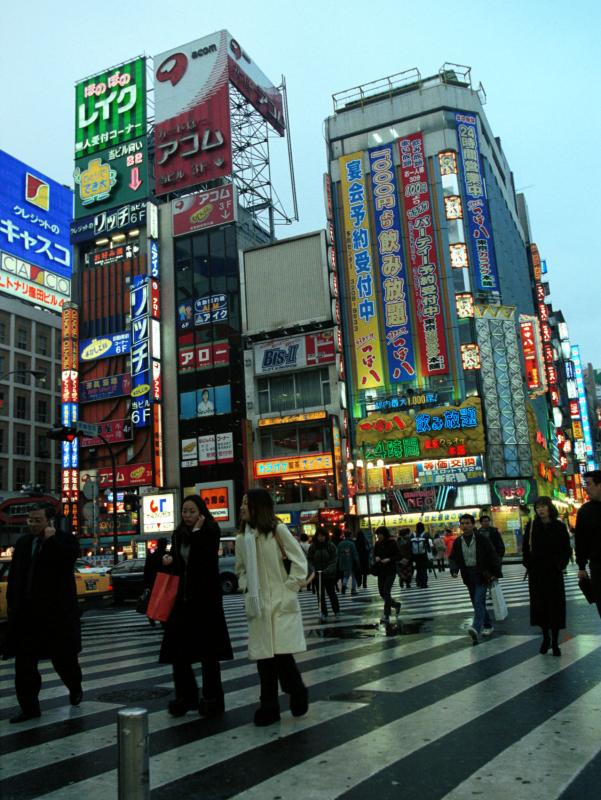
Shinjuku section of modern Tokyo.
24. Occupation
Read Reischauer, pp. 184-202. To what extent does the American Occupation embody "political wisdom"? What was SCAP and what were its immediate priorities? Evaluate General MacArthur's effectiveness as chief architect of the Occupation. Can you explain why he was a proponent of what appears to be an ambitious program of social reform?
25. Postwar Japan.
Read Reischauer, pp. 203-223. How did the politics of the Cold War change American priorities in the Occupation? Can you identify the conditions and policies in the late 1940s and 1950s that lay the groundwork for Japan's phenomenal economic growth?
26. The "Economic Miracle" Begins.
Read Reischauer, pp. 224-250. Consider the role of the Japanese government in promoting commerce, finance, and industry; how is this different from what happens in the United States? Is there a different philosophy at work here? How is American helpful to Japanese economic growth?
27. Education in Japan I.
Read Rohlen, pp. 11-44. Be sure you understand the different schools Rohlen studies. Are there parallels in American education at the secondary level?
28. Education in Japan II.
Read Rohlen, pp. 45-76. What are the goals of a high school education in Japan? In the United States? How are these goals reflected in curriculum? Extracurricular activities?
29. Education in Japan III.
Read Rohlen, pp. 77-110.
30. Education in Japan IV.
Read Rohlen, pp. 241-270.
31. Education in Japan V.
Read Rohlen, pp. 271-305.
32. Period Test #2.
Generally covering all the material we have studied this term, with a concentration on World War II and the Occupation. Same format as period test #1.
33. Stumbling Blocks.
Read Reischauer, pp. 251-278.
34. Economic Superpower.
Read Reischauer, pp. 279-303.
35. Japan Peaks?
Read Reischauer, pp. 303-324.
36. TBA
37. TBA
38. TBA
39. TBA
40. Final Examination.
'Nuff said.

Syllabus copyright © 1987-2006 Ned Gallagher.
All rights reserved.
Last revised:
November 26, 2008