
Department of History and Social Sciences
Choate Rosemary Hall
Wallingford, Connecticut
History 041
AMERICAN GOVERNMENT AND POLITICS
Summer 1999 term
Hypertext Course Syllabus
| TABLE OF
CONTENTS Goals of the Course Texts and Course Materials Program and Workload Schedule of Meetings and Assignments |
Mr. Ned Gallagher Mellon Humanities Center #208, 697-2286 Memorial House #114, 697-2340 Johnson Athletic Center, 697-2417 e-mail: ngallagher@choate.edu Ms. Kathleen Grammatico, Teaching Intern |
"The greatest
dangers to liberty lurk in the insidious encroachment by men of zeal--
well meaning but without understanding."
- Justice Louis Brandeis
This course constitutes a thorough study of the institutions that comprise the United States government. We will analyze the creation and workings of the component branches of the federal government via two distinct academic disciplines: history and political science. At the completion of this course, students should understand the fundamental elements--both in theory and in practice--of the three branches of the federal government, and how each relates to the others, to the states, and to the people.
In addition there will be considerable instruction in the skills needed by all historians, political scientists, and indeed citizens: how to read, how to analyze, and how to express one's self. Specifically, we hope to develop the general intellectual skills of:
The course is designed with these aims in mind to be a coöperative learning experience in appreciating and understanding the rich tapestry of American political life. Needless to say, no such understanding can be taught by someone else; it can only be learned for oneself.
This text for the course--available at the school bookstore--should be purchased by all students immediately:
This course will be orthodox in its presentation: in general, you'll read something before each meeting, and in class we'll discuss what you've read--what I call "Socratic discussion." You'll be expected to write short yet demanding papers, take two period tests and a final examination, and participate regularly in class.
The few papers you write must follow the "empirical essay" format and use the APEC method of argument. If the syllabus doesn't say something to the contrary, then the paper is to be two pages long. That means one sheet written on both sides if you handwrite, or two fronts if you type or word process. If you use notes or bibliography, they may go on a separate sheet. In fact, you may always write as many pages as you want, but the first two will be read and graded.
Schedule of Meetings and Assignments
What follows is what we'll try to cover during the term. It may be adjusted from time to time for any number of reasons. The homework for the next class is always the next assignment unless you are told differently. You'll find each entry on the schedule below contains some instructive questions and ideas you should consider in preparing for class; get into the habit reading the syllabus carefully each night as you begin your homework.
1. Introduction. Read Wilson, pp. 3-16. In class, we'll meet each other, discuss the expectations of the course, distribute materials you'll need, and begin discussion of some of the central issues before us, such as the distribution of political power in a democracy. If there is time, we may also do some work on skills.
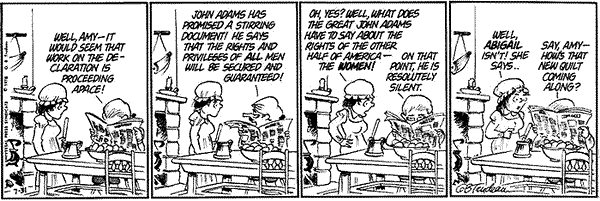
2. Some Theory. Read Wilson, pp. 19-32 and A1-A8 (The Declaration of Independence and Article I of The Constitution) and A26-A29 (Federalist #51). (If you need help in approaching your reading assignments, there is some available online here.) Read the Declaration carefully, even if you've read it before; you ought to be able to summarize the primary grievances the American colonists had in 1776. Be sure you understand the great dilemma before the state-makers in 1787, too: what were they trying to accomplish in "amending" the Articles of Confederation? Also, master the details concerning the 1787 convention, the Great Compromise, enumerated powers, and the hoped-for guarantees.
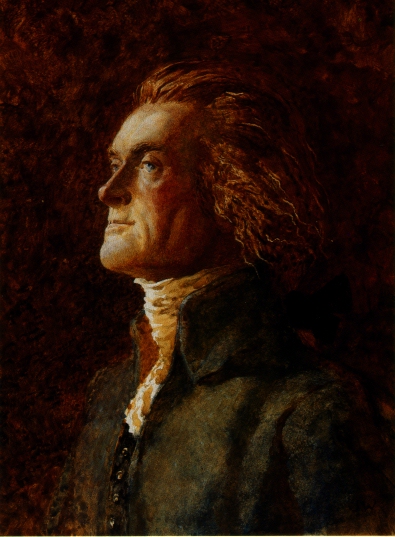 3. More Theory. Read
Wilson, pp. 32-41 and A8-A12 (Articles II-VII of The Constitution) and excerpt from John Locke's Second Treatise On
Government. Some analysis of the powers of government, the powers of the other
branches, and some limits. Ask for the rules on "mass debate." There will such
an event at #4 below. Also, ask for your "number" in class. Some of your
assignments later will depend on this "number."
3. More Theory. Read
Wilson, pp. 32-41 and A8-A12 (Articles II-VII of The Constitution) and excerpt from John Locke's Second Treatise On
Government. Some analysis of the powers of government, the powers of the other
branches, and some limits. Ask for the rules on "mass debate." There will such
an event at #4 below. Also, ask for your "number" in class. Some of your
assignments later will depend on this "number."
4. The Beard Thesis. Read Wilson, pp. 41-49 and A21-A25 (Federalist #10) and an excerpt from Charles Beard's anaylsis of the Constitution (distributed in photocopy form). Also skim Wilson, pp. A13-A20 (the Constitutional amendments) so that you are generally familiar with this material, which we'll talk about later. Every historian since 1913 who has written about the Constitution has had to deal with the Beard thesis. Some love it, some hate it; there seems to be little middle ground. Be able to state it concisely, and then be able to evaluate it and prepare to argue for or against it with your classmates. There will be a mass debate today.
5. Federalism. Read Wilson, pp. 51-68 and Federalist #39 and McCulloch v. Maryland. Here we see federalism, both as a theory and as a real-life controversy. What happened in the Bank case? Get the facts in the case and find out where in the Constitution the applicable sections are located. With whom would you have sided? Why? Period Test at #7. Look ahead.
6. Congress I. Read Wilson, pp. 299-319; Federalist ##58, 62, and 63. How are Congressional Representatives elected? What determines who wins? What conflicts are inherent in what we want in a Representative? What did you learn about the committee system?
7. Period Test #1. Covering all the material studied since the beginning of the term. The first 30 minutes of the class will be devoted to your questions. The test will then last 45 minutes. There is advice online here about test-taking.
8. Congress II. Read Wilson, pp. 319-343. How do the following things influence what happens in the Congress: party, interest groups, committee work, staffs? Note carefully the differences in the way the House and the Senate are organized, in the way the two work, and in who has power in each and why that person has that power. These are very important matters.
9. Congress III. Read Wilson, pp. 343-360. Theoretically speaking, how do laws get passed? Refer to Article I, Section 7 if you need to. But how do laws get enacted in reality? What influences exactly what laws are adopted and what form they take? We may have an in-class essay on some topic involving possible reforms of Congress.
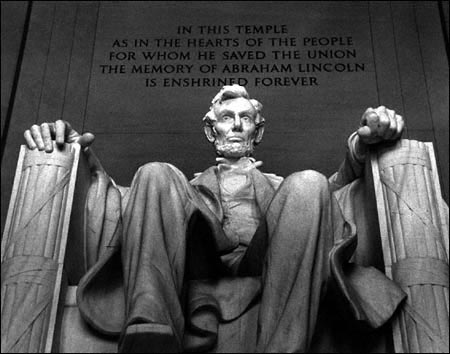 10. The Presidency I. Read
pp. Wilson, 363-376 and Federalist #70. Pay
attention to the description of a prime minister; many people in the Vietnam/Watergate era
thought that was a better system than ours. What are the powers of the President? How have
they evolved from the statements in Article II, Sections 2a and 3?
10. The Presidency I. Read
pp. Wilson, 363-376 and Federalist #70. Pay
attention to the description of a prime minister; many people in the Vietnam/Watergate era
thought that was a better system than ours. What are the powers of the President? How have
they evolved from the statements in Article II, Sections 2a and 3?
11. The Presidency II. Read pp. Wilson, 376-392. Is there a Democratic way of running the White House and a Republican way? Here is Garry Trudeau's take on one president's typical day. Where does the President get his power to make people do things? Be able to describe your answer by reference to an incident in your own life that your classmates may understand. Period Test at #13.
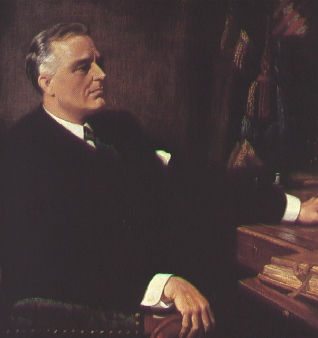 12. The
Presidency III. Read pp. Wilson,
392-406 and U.S. v. Nixon decision.
What powers does the President have that he can use against the other branches? How does
he create his own program? In class, ask for instructions on
how to do a "brief," and for the rules on the Mock Court cases, Brown v.
Board, and Gideon v. Wainwright.
12. The
Presidency III. Read pp. Wilson,
392-406 and U.S. v. Nixon decision.
What powers does the President have that he can use against the other branches? How does
he create his own program? In class, ask for instructions on
how to do a "brief," and for the rules on the Mock Court cases, Brown v.
Board, and Gideon v. Wainwright.
13. The Bureaucracy. Read Wilson, pp. 409-437. To what extent do the masses of unelected civil servants wield power? How do career public officials differ in their behavior from elected politicians? Is this good? Bad?
14. The Courts I. Read Wilson, pp. 439-456 and Federalist #78. Read very carefully the sidebar about Marbury v. Madison on page 442 of the Wilson text. How is the federal court system organized? What duties does it have? Does it have any power of its own? If so, what and from where? If not, how does it get things done?
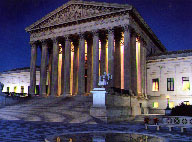 15. The Courts II. Read Wilson, pp. 456-469. What is the Supreme Court's
jurisdiction? What's a "class action"? Note that this is a short assignment, so
use the additional time to work in your assigned groups to prepare for the Brown v.
Board of Education or Gideon v. Wainwright cases to be argued in #15
in Mock Court; details of this assignment and the Mock Court format may be found here.
15. The Courts II. Read Wilson, pp. 456-469. What is the Supreme Court's
jurisdiction? What's a "class action"? Note that this is a short assignment, so
use the additional time to work in your assigned groups to prepare for the Brown v.
Board of Education or Gideon v. Wainwright cases to be argued in #15
in Mock Court; details of this assignment and the Mock Court format may be found here.
16. The Courts III. Read Wilson, pp. 473-496. What do these terms mean as applied to this assignment: applicablity, incorporation, distinguishing two cases, stare decisis? We'll do the Mock Court cases in class today.
17. Period Test #2. Covering all the material studied since the beginning of the term. The first 30 minutes of the class will be devoted to your questions. The test will then last 45 minutes.
18. Prep for Washington. Each student bring to class two questions each in four categories: Executive, Legislative, Judicial, and Regulatory. The questions must be ones that we want asked in Washington. The trip itinerary can be found here.
19-22. SPECIAL PROJECTS. Participants in the Kennedy Institute will be in Washington, D.C. this week. Non-Institute students in the course will have something constructive with which to occupy their time. Stay tuned!
23. The Public I. Read Wilson, pp. 111-140. What are the most important influences on the way a person votes? On the way a person looks at issues? Do those influences affect you the way they affect most people? Prepare in writing a five-question poll of your classmates that you think will enable you to tell how they would vote.
24. The Public II. Read Wilson, pp. 142-159. There are lots of terms that need to be defined here: liberal, conservative, civil rights, middle class, yuppie. What do they have to do with the branches of government as we've studied them and as you've seen them? Completed thank-you letters must be brought to class today.
25. Political Parties. Read Wilson, pp. 163-193. Extra credit problem: bring to class a brief time-line, starting at 1787 and ending at 1990, that shows the development of the current party system. Do not try to do this project if you can't do it mainly from memory. How are the parties different today from what they were in 1861, in 1896, in 1912, in 1936? What's the New Deal Coalition? What is there about the parties that demonstrates what we've learned about separation of powers and federalism? What's good about our two-party system? What's bad? The paper based on your experiences in Washington is due at classtime today.
26. The Fourth Estate. Read Wilson, pp. 267-295. What role does the media play in modern politics? How has it changed in the last forty years? How do print media and broadcast media differ in their political coverage? What is your sense of bias in the media today?
27. Final Examination. Covering all that we've studied during the term. The test will then last 50 minutes.
28. Wrap Up. You will complete end-of-term evaluations in class, so think about any ideas you want to convey to your teachers about the class, the quality of instruction, and your own performance this summer. Final exams will be returned and reviewed. Sadness will begin.
The course is ended; go in peace.
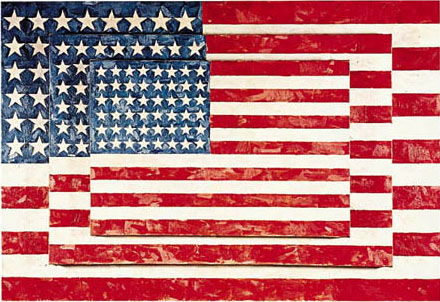
Jasper Johns, "Three Flags"
Last revised: 17 July 2003
Syllabus copyright © 1999 Ned Gallagher. All rights reserved.
Number of visits to this page since
6/26/99: