
Department of History and Social Sciences
Choate Rosemary Hall
Wallingford, Connecticut
History 042
ROOTS OF POLITICAL THOUGHT
Summer 2000 term
Hypertext Course Syllabus
| TABLE OF
CONTENTS Goals of the Course Texts and Course Materials Modus Operandi Program and Workload Schedule of Meetings and Assignments |
Mr. Ned Gallagher Memorial House #114, 697-2340 Johnson Athletic Center, 697-2417 e-mail: ngallagher@choate.edu Mr.
Mike Beland, Teaching Intern |
"If you have
built castles in the air, your work need not be lost; that is where they should be.
Now put the foundations under them."
- Henry David Thoreau, Walden
|
This course is conceived as a study in two distinct disciplines: political philosophy and history. As such, it explores the ideologies of various political systems in the contemporary world from both theoretical and historical perspectives. In other words, we will consider the ideas underlying the dominant political systems of the modern world and examine how those ideas have been put into practice historically. You also will find the discipline of economics provides a useful--indeed a vital--framework for many of our discussions. Our studies will focus on the four primary types of political ideology prevalent in this century: liberal democracy, socialist democracy, fascism, and communism. We will attempt to reach a critical understanding of each system on its own merits rather than attempting to prove the inherent "superiority" of any one system. In addition, we hope to develop the general intellectual skills of:
The course is designed with these aims in mind to be a coöperative learning experience in appreciating and understanding the rich tapestry of Western political philosophy. Needless to say, no such understanding can be taught by someone else; it can only be learned for oneself. These texts for the course--available at the school bookstore--should be purchased by all students immediately:
The following general questions should help you in your efforts to understand the arguments expressed by proponents of different ideologies and in sorting out the often subtle differences of philosophy between these writers. You should be able to answer these questions based on each night's readings. According to the particular political philosophy being articulated:
This course will be orthodox in its presentation: in general, you'll read something before each class meeting, and in class we'll discuss what you've read--what I call "Socratic discussion." You'll be expected to write two short yet demanding papers, take midterm and final examinations, and participate regularly in class. Schedule of Meetings and Assignments What follows is what we'll try to cover during the term. It may be adjusted from time to time for any number of reasons. The homework for the next class is always the next assignment unless you are told differently. You'll find each entry on the schedule below contains some instructive questions and ideas you should consider in preparing for class; get into the habit reading the syllabus carefully each night as you begin your homework. 1. Introduction. No assignment. In class, we'll meet each other, discuss the expectations of the course, distribute materials you'll need, and begin discussion of some of the central issues before us. 2. Defining Our Terms. Read Baradat, pp. 1-12 and 46-62. Try to develop a working understanding of the terms ideology and nationalism as used by Baradat. Think of a few historical examples of ideological movements and nationalistic movements. How is a nation different from a state, according to Baradat? 3. Attitudes, Values, and the Political Spectrum. Read Baradat, pp. 14-43. This is one of the longer assignments you'll tackle this summer, so don't put this off! (If you need help in approaching your reading assignments, there is some available online here.) Be sure you have an understanding of the classifications Baradat outlines and the sources of those classifications. Based on your recollection of American history, how do these classifications relate to American political parties historically? Where would you place yourself on the political spectrum outlined by Baradat? Do you agree with the circular model of the spectrum? Ask about the matrix chart in class.
6. Capitalism and Conservativism. Read Baradat, pp. 85-95, and Cohen, pp. 478-479 and 590-599. Pay close attention to Baradat's summary of Adam Smith and classical liberal economic thought. Do you subscribe to Smith's "hidden hand of the market" notion? Would you describe Edmund Burke as a democrat? What are his basic assumptions (remember the generic questions!)? Whose interests does he seem to have in mind? Why is capitalism inevitably a prerequisite for political freedom for Milton Friedman? In what sense are Burke and Friedman conservatives? [Review Baradat's description of conservatism (pp. 23-28) if necessary.] In what sense is Friedman an intellectual heir of Adam Smith?
10. Research and Writing. CLASS MEETING IN THE MELLON LIBRARY. You will have the class time available to work on your paper. Conferences withteachers may be scheduled as needed. Useful advice on paper preparation may be found here and here. 11. Ideology and Human Psychology. Paper #1 due in class. We'll have a screening of the film Faces of the Enemy in class. Discussion to follow. 12. The Democratic Process. Read Baradat, pp. 113-139. This reading should serve as an effective summary of our discussions about liberalism and democratic theory to date. Think about the different historical applications of democratic systems of government; how does the structure of the United States government reflect values distinct from those suggested by European parliamentary models? Note the upcoming exam in class #12. 13. Midterm Examination. A comprehensive exam covering all material since the beginning of the course. Think about the generic questions; be able to talk about specific thinkers and their ideas, as well as comparatively through time. There is advice about test-taking online here. 14. Anarchism; Early Socialist Thought. Read Baradat, pp. 141-157 and 192-198, and Cohen, pp. 21-29. Note the different starting points from which various anarchists arrive at the same fundamental position. Do you think Thoreau was a true anarchist? How did the French Revolution and the Industrial Revolution influence early socialist thought? What is utopianism and how is it linked to socialism? Why was this variant of socialist thought closely connected to the French? How do the basic assumptions underlying socialism differ from those behind liberal thought?
16. The Economics and Politics of Marxism. Read Baradat, pp. 184-192 and 198-201, and Cohen, pp. 47-60. Bring to class your questions; students in this course always find Marxist thought fascinating and challenging; you should have lots of questions to ask. Many observers at the turn of the century would argue that communism has run its course. Do you agree? If so, why did that happen? 17. The Soviet Experiment and The Eastern Bloc. Read Baradat, pp. 201-216 and 229-235, and Cohen, pp. 130-138, 155-161. The notion of the party as a vehicle for socialist change is Lenin's central contribution to Marxist thought. Consider his role in creating a revolutionary party in Russia. Pay particular attention to the adjustments made by Lenin to fit Marxist theory to the circumstances of Czarist Russia. How does Leninism differ from "pure" Marxism? Also, think about Lenin's views of imperialism. Note especially the conflict between the ideas of Trotsky ("international revolution") and those of Stalin ("revolution in one country"). How faithfully were the ideas of Marx and Lenin implemented in the early history of the Soviet Union? Why did communism fail in the USSR and Eastern Europe? How will forty years of being Soviet satellites continue to shape the post-Cold War Eastern Europe emerging before our eyes?
19-22. SPECIAL PROJECTS. Participants in the Kennedy Institute will be in Washington, D.C. this week. Non-Institute students in the course will have something constructive with which to occupy their time. Stay tuned! 23. The Rise of Fascism. Read Baradat, pp. 237-243 and 264-271, and Cohen, pp. 289-299. Consider the contributions of Hegel and Rocco to this very distinct ideological school. Rocco's comparisons of fascism to other ideologies are worthy of special attention. How did historical conditions give rise to fascist thought? Pay particular attention to the organization of the Italian fascist state. How did it attempt to handle the forces released by the Industrial Revolution? How does the corporate state illustrate fascist social theory? 24. Hitler and Nazism. Read Baradat, pp. 243-264, and skim Cohen, pp. 327-342. This assignment is intentionally short to give you time to work on Paper #2. Compare and contrast Germany's National Socialism with fascism in Italy. In what ways were they most similar? Most different? Note especially the role of mythology (e.g., themes in Wagner's operas) in pre-Nazi Germany. How does this relate to Faces of the Enemy? What was the Italian equivalent of this mythology? 25. The Developing World. Read Baradat, pp. 273-289. Consider how questions of distribution of global resources will impact the politics of the twenty-first century. Is the current framework of nation-states well suited to grapple with emerging problems of an ever-expanding world population in an increasingly fragile environment? Is there a better model out there? 26. RESEARCH. Class will meet in the Andrew Mellon Library so that you may work on Paper #2. 27. Final Examination. 'Nuff said. Final revision for Paper #2 due at the beginning of class. 28. Wrap Up. You will complete end-of-term evaluations in class, so think about any ideas you want to convey to your teachers about the class, the quality of instruction, and your own performance this summer. Final exams will be returned and reviewed. Sadness will begin. The course is ended; go in peace. |
Last revised: 20 May 2003
Syllabus copyright © 1999, 2000 Ned Gallagher. All rights reserved.
Number of visits to this page since
6/26/99:
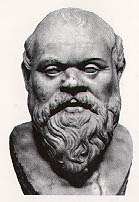 4.
Socrates, Hobbes, and the Social Contract. Read Plato
(Socrates),
4.
Socrates, Hobbes, and the Social Contract. Read Plato
(Socrates), 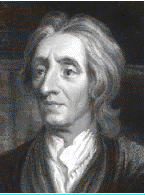 5.
Locke and Rousseau. Read Baradat, pp.
71-83, and
Cohen, pp. 392-398 and 413-419. John Locke was arguably the most significant thinker in
the development of classic democratic theory. What historical circumstances influenced
Locke's thinking? How? What is Locke's conception of natural law? Compare and
contrast the ideas presented by Hobbes and Locke. In what sense does Locke's argument
build on Hobbes' vision of society? Where do the two differ most drastically? Rousseau is
difficult to understand the first time around. Grappling with the generic questions should
help you to understand his argument; in particular, think about his view of human nature.
Can you envision Rousseau's concepts of the organic society and the general
will in today's world?
5.
Locke and Rousseau. Read Baradat, pp.
71-83, and
Cohen, pp. 392-398 and 413-419. John Locke was arguably the most significant thinker in
the development of classic democratic theory. What historical circumstances influenced
Locke's thinking? How? What is Locke's conception of natural law? Compare and
contrast the ideas presented by Hobbes and Locke. In what sense does Locke's argument
build on Hobbes' vision of society? Where do the two differ most drastically? Rousseau is
difficult to understand the first time around. Grappling with the generic questions should
help you to understand his argument; in particular, think about his view of human nature.
Can you envision Rousseau's concepts of the organic society and the general
will in today's world? 7. The
American Experiment. Read Baradat, pp.
95-103, Cohen,
pp. 419-423, and 475-478. Messrs. Jefferson and Madison were the premier democratic
theorists directly involved in the creation of this Republic. How did the writings of
Hobbes, Locke, and others influence them? What fundamental assumptions (generic questions
time!) did the Founding Fathers buy into in designing this government? The idea of
democracy occupies a central position in the landscape of American myth; to what extent is
this country really a democracy? Consider the historical conditions preceding and
surrounding the creation of the American Republic. What problem were the framers of the
Constitution most worried about?
7. The
American Experiment. Read Baradat, pp.
95-103, Cohen,
pp. 419-423, and 475-478. Messrs. Jefferson and Madison were the premier democratic
theorists directly involved in the creation of this Republic. How did the writings of
Hobbes, Locke, and others influence them? What fundamental assumptions (generic questions
time!) did the Founding Fathers buy into in designing this government? The idea of
democracy occupies a central position in the landscape of American myth; to what extent is
this country really a democracy? Consider the historical conditions preceding and
surrounding the creation of the American Republic. What problem were the framers of the
Constitution most worried about?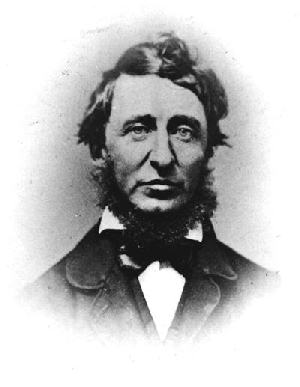 8. Two 19th-Century American Thinkers. Read Henry David Thoreau,
  9. Modern Liberal Thought.
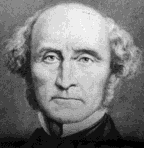
Read Baradat, pp. 104-111, and Cohen pp. 444-448, 609-613, and 377-383. John Stuart Mill's
ideas on liberty as a fundamental societal value are vital to modern liberal democratic
theory in the Western world. Study Mill's argument very carefully and be sure to consider
the generic questions. Do you agree with Mill's basic position? What potential problems
can you find in Mill's theory? When reading Green and Dewey, consider the changing
notions of the obligations of the state in liberal thought. How would you describe the
transition from the Lockean ideals embraced by the Founding Fathers to the adoption of the
New Deal and the ethic of the welfare state in the twentieth century?
9. Modern Liberal Thought.
Read Baradat, pp. 104-111, and Cohen pp. 444-448, 609-613, and 377-383. John Stuart Mill's
ideas on liberty as a fundamental societal value are vital to modern liberal democratic
theory in the Western world. Study Mill's argument very carefully and be sure to consider
the generic questions. Do you agree with Mill's basic position? What potential problems
can you find in Mill's theory? When reading Green and Dewey, consider the changing
notions of the obligations of the state in liberal thought. How would you describe the
transition from the Lockean ideals embraced by the Founding Fathers to the adoption of the
New Deal and the ethic of the welfare state in the twentieth century? 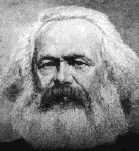 15.
Karl Marx as Socialist. Read Baradat, pp.
159-183,
and Cohen, pp. 76-85 (top). What is the relationship between early socialism and the birth
of Marxist theory? How does Marx's vision differ from that expressed in utopian socialism?
Consider the role of history in Marx's work. Read the "Communist
Manifesto" carefully. Remember, it is one of the most profoundly influential
documents in human history. What are the circumstances under which it was written? What is
the dialectic Marx and Engels talk about?
15.
Karl Marx as Socialist. Read Baradat, pp.
159-183,
and Cohen, pp. 76-85 (top). What is the relationship between early socialism and the birth
of Marxist theory? How does Marx's vision differ from that expressed in utopian socialism?
Consider the role of history in Marx's work. Read the "Communist
Manifesto" carefully. Remember, it is one of the most profoundly influential
documents in human history. What are the circumstances under which it was written? What is
the dialectic Marx and Engels talk about?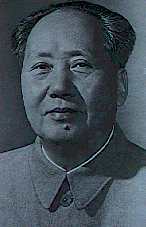 18.
"The Great Helmsman." Read Baradat, pp.
216-229; in class, we'll read a handout on the history of World War II as seen through the
perspectives of competing Chinese Marxist ideologies. How was Marxism-Leninism adapted to
China's unique situation? Why didn't "pure" Marxist theory apply to China in the
early twentieth century? What did Mao Zedong consider his power base? In the
handout, history is used as a metaphor in describing two different philosophical
positions. Try to remember when these interpretations were written and what else was going
on in Asia at the time. We will examine the Great Proletarian Cultural Revolution and its
aftermath as a critical period in the history of Chinese Marxism.
18.
"The Great Helmsman." Read Baradat, pp.
216-229; in class, we'll read a handout on the history of World War II as seen through the
perspectives of competing Chinese Marxist ideologies. How was Marxism-Leninism adapted to
China's unique situation? Why didn't "pure" Marxist theory apply to China in the
early twentieth century? What did Mao Zedong consider his power base? In the
handout, history is used as a metaphor in describing two different philosophical
positions. Try to remember when these interpretations were written and what else was going
on in Asia at the time. We will examine the Great Proletarian Cultural Revolution and its
aftermath as a critical period in the history of Chinese Marxism.