![[Three Flags]](images/threeflagsbig.jpg)
Jasper Johns, "Three Flags" (1938)
Department of History, Philosophy, Religion, and Social Sciences
Choate Rosemary Hall
Wallingford, Connecticut
History 310
UNITED STATES HISTORY
Hypertext Course Syllabus
Fall 2007 term
| TABLE OF CONTENTS Goals of the Course Daily Preparation Classroom Work Written Work Texts and Course Materials Program and Workload Schedule of Meetings and Assignments |
Contact Information |
Jasper Johns, "Three Flags" (1938)
"Each age will re-write the history of the
past anew . . ."
- Frederick Jackson Turner
This text for the course--available at the school bookstore--should be purchased by all students immediately:
This course will be orthodox in its presentation: in general, you'll read something before each class meeting, and in class we'll discuss what you've read--what I call "Socratic discussion." You'll be expected to write short yet demanding papers, take period tests and a departmental final examination, and participate regularly in class.
Every effort has been made to keep the length of daily assignments manageable. Many worthwhile assignments were abbreviated or scrapped from the syllabus altogether. It's important, therefore, that you commit yourself now to keeping up with what is included among the assignments below; you'll be expected to complete the assigned homework before each class.
What follows is what we'll try to cover during the term. It may be adjusted from time to time for any number of reasons. The homework for the next class is always the next assignment unless you are told differently. You'll find each entry on the schedule below contains some instructive questions and ideas you should consider in preparing for class; get into the habit reading the syllabus carefully each night as you begin your homework.
Schedule of Meetings and Assignments
1. Course Organization.
No assignment. We'll spend the time in this class getting to know one another.
2. Habits of Excellence: Study Skills and The Empirical Essay .
Please prepare the following for class #3: (a) read the Course Expectations document and memorize the definitions (e.g., political history) given and the course credos; (b) study The Pink Sheet and The Green Sheet very carefully, and skim The Gold Sheet so you are familiar with its contests and can refer to it later; (c) study the “Statement on Academic Integrity” in the Student Handbook; (d) prepare for a quiz on (a) through (c) that will ask you to think about things; and finally, (e) if you don’t already own one, buy a paperback dictionary of no fewer than 600 pages and an 8.5"x11" three-ring loose-leaf binder with a section for use only in history and bring both to class.
U.S. HISTORY, PART I: "THE EMERGENCE OF A FEDERAL REPUBLIC"
The goals of the first part of this course are essentially fourfold: (1) to refine the skills essential to the study of history; (2) to acquire broadly-based survey knowledge of the history of the Republic from its colonial beginnings through the end of Reconstruction; (3) to explore in some depth a thematic understanding of U.S. history in this period as the emergence of a federal republic; and (4) to learn about the work of the historian and the principles of historiography.
3. Terra Nova.
Read Davidson, pp. 1-23. Some things to ponder as you read: What accounts for the economic, social, and political diversity of the occupants of the land mass now known as America after about 5500 BC? What cultural circumstances made the Native Americans poor competition for the Europeans? Note the differences between "egalitarian" and "hierarchical" Indian tribes. How did European rivalries encourage and/or retard exploration? What is the myth of the "island paradise" as it was envisioned by Europeans? Be prepared to distinguish among the various colonies.
4. European North America.
Read Davidson, pp. 23-36. Also read the online excerpt from the works of John Locke. What ideas and forces lay at the heart of the thinking of Martin Luther and John Calvin? How did these ideas affect the lack of interest in exploration on the part of the British and French in the 16th century? What changed? What was Locke's central contribution to Western political philosophy--a development that later would have a tremendous influence on the founders of the United States?
5. Colonial Culture I: Southern Colonies.
Read Nash, pp. 98-104. This is the first chapter in which you'll see so much data on related but different items. But here, your notes really have to work to make sense out of the material. The best way is to do them in the form of a matrix chart. Down the side: general headings, according to your judgment. Along the top: some form of who, what, where, and when, then why, how, and so what?
The Virginia Colony
eResource: John Smith's "The Starving Time"
Questions for Consideration:
Compare Smith's description of the early Jamestown colonie to the Nash description of life in the South betwen the 1680's and 1750's. What has changed (this is the easy question) between these two time periods? Why has it changed? Who constitutes the members of the two Virginia communities? Is the South a single community by 1750? What other groups can you detect from the writings, and what are the attitudes towards those communities? What was life like as a slave? What were the forms of resistance and rebellion that occurred?
In Class:
1. Explore in depth John Smith's "The Starving Time". What can a primary document tell us? What can't a primary document tell us? What challenges are inherent in primary documents? If they are so difficult, why use them? We will use portions of the eResource Tutorial: How to Analyze Primary Sources
Use this set of tutorials to learn what questions to ask of each primary source that you study and how to craft the answers.
2. Discuss the reading questions.
3. Preview assignment #2
6. Colonial Culture II: Southern Colonies Continued.
Read Davidson, pp. 58-73. Derive your own queries from your experience so far; remember: wwww/whsw. There will be a period test at #11, below.
7. Colonial Culture III: Northen Colonies.
Read Nash, pp. 61-71.Were there human, geographic, and institutional differences between the northern and southern colonies from the beginning? If so, do you think these differences still exist? Since many of these colonies were founded by a "company," is it correct to think of the early settlers as "employees"? Remembering that all of Europe was ruled by despotic kings at the time, what precursors of American freedom and democracy do you see in the colonies in these 17th-century events?
Puritan New England
eResource: "The Puritans" - Chapter 3 lecture (NOT chapter 2's lecture by the same name)
Suggested, but not required:
eResource: "The Puritans" - Chapter Two
Essential Questions:
What is Puritanism? Who were the Puritans? How are Pilgrims and Puritans different? What is the connection between the America and the Puritans - what was their purpose in coming here? How is this different from the Virginia colonials? How do Puritans create a sense of community amongst themselves (hint, what is the role of religion here?)? What are the strengths and weaknesses of Puritan living from a 21st century perspective? What do their attitudes seem to be about Native Americans?
For Class:
1. Answer the following question to be turned in at the start of class: What do you think are the strengths and weaknesses of Puritan living from a 21st century perspective?
2. Examining Art Historically. Watson and the Shark: Reading the Representation of Race
John Singleton Copley's Watson and the Shark provides an opportunity to understand contemporary ideas about race.
3. Examin the questions above.
4. Preview Assignment #3
8. Colonial Culture IV: The Puritans.
Read pp. 50-71 in G&B. Who were the Puritans? How were they different from the Separatist "Pilgrims" who founded Plymouth Colony? Of what significance is the Mayflower Compact? How did the Massachusetts Bay Colony establish political institutions independent of England? How were both of these colonies different from those in the Chesapeake? Is Winthrop's "city on a hill" the same as the myth of the "island paradise," or is it different? Be thinking about Anne Bradstreet as you read this history.
9. Colonial Culture V: Middle Colonies.
Read Nash, pp. 81-87 and 92-98. Make a list of the essential characteristics of 17th century Virginia and Maryland. What were mercantilism and indentured servitude? Note the map as a reference for the places mentioned. Also note the early political independence of Virginia's elected assembly. Is there a system of class privilege developing on the Chesapeake? What are the internal and external sources of tension that contribute to Bacon's Rebellion? What led to the increase in importation of slaves after 1680?
Changing Values in the Colonial World
Glasgow Currant, September 1763
Glasgow Currant, September 1760
eResource: "Laws of Virginia, 1661, 1662, 1691, 1705"
AND
Lecture Launcher Video: Slavery in the Chesapeake
Questions for Consideration:
In what ways are the colonists still connected to England? How is 'America' changing the colonists? To what degree do you think this was inevitable? Why? How does Nothern society differ from Southern society by the end of the 17th century? Who are indentured servants? What has been their role in colonial history? In what ways are they different from slaves (think in terms of cultural background, economic opportunity, legal standing, and social status).
In Class:
1.
Discuss how to take effective notes during class.
2.
Review the above questions with respect to the readings.
3.
Preview Assignment #4
10. Eighteenth Century America.
Read Nash, pp. 111-123. Most of this reading is about the factors that divided colonial America. Make sure that your notebook reflects a careful list of these developments. Was slavery a benign influence on colonial life? What was the Stono Rebellion and why is it significant?
Commerce/Religion/Politics
Southern Plantation Life
Paul Revere by JS Copley
Crevecoeur "Letters from an American Farmer" - see file above
Questions to Consider:
List the key changes that are happening in the colonies regarding Commerce, Politics, and Religion in the1700's. In what ways are these issues connected (remember that business, politics, and religion do NOT exist on their own). Where do you see influences of one issue on the other? Who is Crevecoeur? How does he see the colonial experience as an unique experience?
In Class:
1.
Written Homework: To be handed in at the start of class. Examine the two art images above. How does each capture some of the characteristics of their region? We will start class by discussing these images.
2.
Discuss Reading Questions
3.
Preview Assignment #5
11. The Great Awakening.
Read Davidson, pp. 119-136. The section on the Great Awakening is the first of many we'll study on reform movements. Look up "the Enlightenment" in an encyclopedia or some other text, and distinguish it from the Great Awakening. To some degree, don't the values at the heart of both movements conflict? Does the Jonathan Edwards sermon reflect your understanding of this historical period? How did the colonial governmental systems mirror and contrast with English political institutions and practices? Note the Albany Congress as a quixotic early attempt at colonial unity. Certainly we are still at a point of political decentralization in colonial development. Why? Could it have anything to do with the social divisions that still exist between and within the colonies?
12. Period Test #1.
Covering all the material studied from the beginning of the term. The most basic skill you'll acquire is to learn what is important enough to study, so don't ask me what's going to be on the test. Instead, study everything you think is important. Read "Answering Historical Identification Questions" and "Writing Essays on History Tests" before you begin studying. The night before the test, I will be available in Memorial House from 9:00 to 9:30 P.M. to answer any questions you may have. You may bring an unmarked paperback dictionary into this and all other exams in the course, but you may not share it with anyone else.
13. Imperial Zenith.
Read Nash, pp. 128-137 and 140-141. This is the first time a major European conflict draws Americans into war; it won't be the last. Make a matrix chart listing the strengths and weaknesses of the competitors. Which of the characteristics seemed most important at the outset? Which turned out to be the most important? What do you think will be the main outcome of this great British military victory? Does the French surrender open up the possibility for concentrated dislike by the colonists of the British? And vice versa? In both cases, why? What were Grenville's actions at the war's end? Why did he feel he needed to act? How did European politics affect the settlement known as the Treaty of Paris (1763)? (By the way, this is the first Treaty of Paris; don't get it mixed up with the treaty of the same name that, ironically, settled England's capitulation to the colonies after the Revolution in 1783.) Look at the Proclamation of 1763 and the Stamp Act together. Can you explain why the Stamp Act generated so much hostility on the part of the American colonists? Why did Parliament initiate the legislation in the first place? Try to understand the mixed feelings the American colonists had about their relationship with the Britain. What were the advantages of the relationship? Disadvantages? Also, pay attention to some of the important names, terms, and concepts introduced, such as the Navigation Acts. How does this relate to John Locke's notion of property? Try to understand how the British thought they were being reasonable in governing byvirtual representation.
War and Change
eResource: Ben Franklin "Testimony Against the Stamp Act"
Recommended, but not required:
The Struggle for Dominance [video - eResource]
Questions for Consideration
How would you describe the importance of the American colonies to the larger British Empire prior to the Seven Year's War? How did the American colonies become involved in the war? What is at stake for the Native American tribes in this fight between France and England? Describe how this war changed the relationships between the colonies and England. What are the colonists angry about? Are these colonists 'Americans' yet? Have evidence to prove your point one way or the other.
For Class:
1.
Begin Chart of events leading to the Revolutionary War. Make a column for each of the following headings: Event, Date, Leaders Involved, Colonial Reaction, What it means for creating an 'American' Identity. I will be checking on these over the next few days.
2.
We will be examining Paul Revere's etching of the Boston Massacre to the Boston Gazette's description in class.
3.
Preview Assignment #6
14. Mounting Tensions.
Read Nash, pp. 141-149. Be sure you understand the essential data--the who, what, where, and when--about the controversial legislation so you can frame an analysis--the how, why, and so what-of what happened between Britain and her colonies across the Atlantic; for best results, use a matrix chart to keep track of the major issues and events of the period: the Quartering Act, the Boston Massacre, the Tea Act, the Gaspee Commission, the Boston Tea Party, the Coercive (or Intolerable) Acts, and the Québec Act. From the perspective of the colonists, there was something dramatically different about the Townshend Acts from previous Crown action. Explain. What institutions are at stake, from the colonists' viewpoint? Interesting question: if you were in charge of imperial policy in the 1760s, what would you have done differently to prevent the American Revolution? Would the colonists have accepted your policy? Would the English?
Creating An American Identity
eResource: "The Liberty Song" [Audio]
Questions for Consideration:
What is the ideology of revolutionary Republicanism? How is this linked to the Enlightened theory of government and property? How do the colonists define 'liberty'? How do you think this fits given what we have talked about regarding slavery? Were all Colonists unhappy with England/Parliament? What other grievences did some colonists have?
In Class:
1.
To be handed in at the start of class: Political cartoons of the 1700's. Examine the cartoons on pages 144 and 147. Read the captions carefully and then compare and contrast how each cartoon uses the image/ideal of a woman to help make its point.
2.
Continue Charts of events leading to the war.
3.
Discuss the above questions with regards to the reading.
4.
Preview In-class essay.
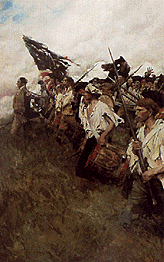 15. Philadelphia Freedom.
Read Nash, pp. 154-157. Also read the Declaration of Independence. How did the war go in its early stages? What were the basic strategies of each side? What factors helped/hindered each side? Pay attention to the mismatching of British military power and British political wisdom. Are you surprised that it took so long for the Declaration to be issued? What are the two parts of the Declaration? We'll have discussed the motives of the founders by this point, but analyze the words here. Is this essentially a political or an economic document? Note the tone and substance of Trumbull's paintings accompanying the text. Why were loyalist sentiments stronger in the South? Prepare for a possible debate on this resolution: The British colonial policy from 1763 to 1775 was unreasonable, repressive, and seems almost to have been designed to unify the colonists in revolt.
A Call for American Independence
Handout: Thomas Paine's Common Sense
Jefferson, "Rough Draft of the Declaration of Independence"
http://www.ushistory.org/declaration/document/congress.htm
The sections that are red were removed from the final version of the document.
Questions for Consideration:
Which is more compelling in Paine's argument - his logic or his rhetoric? How does Paine push the colonial discussion further? How necessary a document was Common Sense in leading to the Declaration of Independence? What are the differences between Jefferson's rough draft and the document's final draft? Why were these necessary? What are the goals of the American Revolution as described in the D of I?
In Class:
1.
To be handed in: Which document was more important in leading to the American Revolution? Explain your answer.
2.
Clip from the Liberty Video by PBS
3.
Discussion of the above questions
4.
Preview of Assignment #9
17. Lexington Green I: Two Mysteries.
Read Bennett, pp. 1–21. Here we pause to examine this one event in considerable depth, not because it was so important but because from it we can learn important things about how historians work. They are something like detectives: they research in primary materials, test for plausibility, and record what seems to them the truth, absolving and charging as they think credible. You do the same in reading this book: be like a detective. What did happen on Lexington Green? What happened in Watts? Remember: as an historian, your responsibility is to tell what happened. Look ahead to #20, and keep your eyes and ears open to topic possibilities.
18. Lexington Green II: Historiography.
Read Bennett, pp. 22–33. Notice the wide range of views. Historiography is the study of what has been written about history. Its first law is found near the very beginning of this document. What does Turner mean? Relate your answer to these readings. A matrix chart highlighting the renditions presented by each historian will be helpful.
19. Lexington Green III: Interpretation of Data.
Read Bennett, pp. 46–56. Notice the differing ways in which history can be presented. Which do you find the most pleasant? The most believable? The most useful? Don’t just rush through the assignment; study the writings to see which has truth in them. How does Plato’s allegory of the cave help us deal with the dilemma of the historian? Comparative historians: see #21 below, and volunteer before we begin this class.
16. Winning Independence.
Read Nash, pp. 157-169. The British Empire represented the most powerful military force the world had seen until that point in time; how, then, was a ragtag organization of colonial militiamen eventually able to claim victory at the Treaty of Paris in 1783? What do you think of Washington's leadership during the fighting? How competent was the Continental Congress? How could the British have quelled the rebellion after 1775? What was the significance of the alliance with the French and what were France's motives? Can you identify turning points in the Revolution? Can you find more examples of the mismatch between military might and political wisdom? Keep track of how each side was faring in different regions. Know the Battles of Lexington (1775), Trenton (1776), Saratoga (1777), and Yorktown (1781). Ultimately, why were the Americans successful?
The War for American Independence
George Washington Crossing the Delaware, 1851
Recomended, but not required:
eResource: The American Revolution [video]
Questions to Consider:
What mistakes did the British make in fighting the war in the North? In the South? How about the rebellious colonists? What limitations did the colonists work under (hint: think about the Articles of Confederation)? How, and why, were the Native Americans involved in the war? What does Nash see as the keys to winning the war? Why didn't the British win this war?
For Class:
1.
To be handed in at the start of class: Examine the image above. To what extent does the painting of Washington's crossing of the Delaware River accurately capture the nature of the Revolutionary war in late 1776 from the colonials perspective? Remember that he hadn't captured Trenton yet - he was on his way there! You may find this link to interesting in thinking about the artist and the painting. http://www.metmuseum.org/explore/gw/el_gw.htm
2.
Discussion of the reading with regards to the questions above
3.
Clips from LIBERTY! the series by PBS.
17. Paper #1 Due.
Topic to be announced.
18. You Say You Want A Revolution?
Read Nash, pp. 169-178. This article is classic historiography; it's about what historians of various eras have written about the Revolution, and not about the Revolution itself. Recall that each age writes its history anew, and make the connections between the various views--or schools of history--and the eras when written. There are about a half-dozen mentioned here.
Choosing Identities
eResource: Slave Petition to the Massachusetts House of Representatives [document]
Questions for Consideration:
Why does the author call the American Revolution a Civil War? Do you agree? Who were loyalists, and why? What was the role of African Americans in the war? What was the war like for civilians? How does the image above compare to the descriptions of the war from the text?
In Class:
1.
We will examin the Muster Roles closely to see what they can tell us about the colonies during the Revolution and about the continental army.
2.
Discuss reading in the context of the questions above
3.
Preview Assignment #10
19. Interpretation: Revolution or Revolt?
Read Nash, pp. 178-186. We'll break down this period in American history with some attention to the historiographical context. Consider these essays with the last assignment on the "schools" of history in mind.
Revolutionary Politics
Abigail Adams: "Remember the Ladies"
http://www.masshist.org/digitaladams/aea/cfm/doc.cfm?id=L17760331aa
Questions to Consider:
What were the basic beliefs of Republican ideology? How were they translated into practice in these new governments? Where were the contradictions in Republican ideology and practical reality in the new nation? Based on Abigail Adams's letter to her husband John Adams, what was the role of women in Revolutionary America?
In-Class:
1. Discuss the reading with regards to the above questions.
Overview:
Though independence had been won, the struggle over political power and control of the revolutionary heritage continued. As Benjamin Rush, Philadelphia physician and revolutionary patriot, explained: "The American War is over, but this is far from being the case with the American Revolution. On the contrary, nothing but the first act of the great drama is closed. It remains [for us] . . . to establish and perfect our new forms of government." Events would soon demonstrate how difficult, and how important to the nation's future, that task would be. Controversy between Federalist supporters of the national government and the emerging Jeffersonian Republican opposition first erupted over domestic policies designed to stabilize the nation's finances and promote its economic development. Those policies revealed deep-seated conflicts between economic interests and raised urgent questions of how the new constitution should be interpreted. What was the proper balance of power between state and national governments? How should governing authority be allocated between the executive branch and Congress? Much depended on the answer to those troubling questions. Within a few years, international events further roiled American politics. The French Revolution and a successful revolt by black Haitians against French colonial power in the Caribbean-the two most dramatic events in a larger web of democratic insurgencies against established authorities that reached from Europe to the Americas-inflamed congressional politics and roused the people at large. By the last years of the 1790s, the prospect of war with France and Federalist security measures such as the Alien and Sedition Acts brought the nation to the brink of political upheaval. That prospect was narrowly avoided by the Federalists' defeat and Thomas Jefferson's election as president in 1800. Having captured the presidency and control of Congress, the Jeffersonian Republicans set about the task of refashioning the government. At home, they dismantled the Federalists' war program, reduced the national debt, promoted westward expansion, and emphasized state rather than national authority. Abroad, they struggled less successfully to protect American commerce on the high seas and avoid embroilment in European war. Adding to the political crisis was widespread anxiety over the nation's novel and still unproven "experiment" in creating a sprawling, diverse republic. The absence of fully developed political parties skilled in forging compromise among leaders at the nation's capital and organizing the surging political energy among the people compounded the problem. By the time Thomas Jefferson left the presidency in 1809, it was apparent how fragile, and yet how resilient, America's new government was proving to be.
20. The Critical Period.
Read Nash, pp. 195-203 and 206-208. You may disagree with me over the history of the period, so do the reading especially well. What was the nature of the government during the Revolution? Why, after the galvanizing effort of fighting these heroic battles on the field of war, was it so difficult for the country to unite politically after the fighting stopped? What were the weaknesses of the Articles of Confederation? What specific quarrels cropped up among the colonies? What was the solution? Were these political or economic arguments--and what social divisions did they reflect? Was the Confederation government compatible with the goals of the 1776 patriots? Compare the content of the Declaration with the characteristics of the Articles. What did the Confederation do well? What did it do poorly? Would you have liked to live under the Confederation? Why or why not? Think carefully.
An Emerging American Nation
eResource: Military Reports on Shays' Rebellion
Questions to Consider:
Make a list of the key issues that the colonies had to deal with in the aftermath of the Revolution. What were the events leading up to Shays' Rebellion? Why were the farmers unhappy? Should they have rebelled? Or did they go too far? List the major individuals of the Constitutional Convention. Why was this Convention called?
In Class:
1.
To be handed in at the start of class: Were the followers of Daniel Shays' right to rebel, or did they go too far?
2.
Clips from the Liberty! video.
3.
Introduction to the Constitution of 1787.
21. Lecture.
Read Nash, pp. 208-210. and the Preamble and Article I of The U.S. Constitution. Where does the Preamble base the power of the Constitution? How is this different from the Articles of Confederation? Note the powers of Congress; what surprises you? What has been the effect of the two amendments? Locate the Connecticut Compromise (also called "the Great Compromise"), the 3/5 Compromise, and the 1808 Compromise in the text.
We will be using an outside website to study the Constitution of the United States. As you read sections of the Constitution you can mouse over the text and explanations will appear in the bottom window.
Questions to Consider:
According to Article I how democratic is the legislative branch in 1787 (who is elected directly by the people and who is not)? Can you tell which provisions were the result of consensus and which were due to compromise? What were some of the compromises necessary to make the Constitution possible? Look over section 8 of Aritcal One. What provisions appear to be most open to differing interpretations? Why are the different possibilities for interpretation significant?
In Class:
1.
Examination of the Constitution with regard to the questions above.
2.
Clip on How a Bill Becomes a Law.
3.
Preview next assignment.
22. Founding Fathers.
Read Articles II & III. Were the Founding Fathers conservative or radical? What do you mean by those terms? Look up the word reactionary in a dictionary before coming to class. Was the adoption of the Constitution a rejection of the principles of 1776?
What branches of the government do Articles II and III set up? Make a list of the Powers of the President. How are the offices of both branches filled? Does this seem to be very democratic? Think over Articles I, II, and III - how much control do 'the people' have over the national government? Why do you think it is framed this way? What checks and balances can you find? What separate powers? Does anything in here remind you of the British imperial policy of 1763-1775? Why is treason the only crime specifically detailed in the Constitution? [If you can locate Richard II's very different treason statute, adopted by Parliament in 1397, you get a 10/10 quiz grade. No other treason law will do.]
In Class:
1.
Presentation on the Judiciary Branch.
2.
Role of the President in American Politics
23. The Constitution.
Read Articles IV - VII and the Bill of Rights (Amendments I-X) and skim the remaining amendments. What oversight of the Founding Fathers did the XIIth Amendment seek to cure? What separate powers does the President enjoy? How does the Constitution cope with the resignation of a President? Of a Vice-President? Find out how these things were used in the case of Nixon and Agnew, Ford, and Rockefeller. Did any problems arise? What had been the system before the XXVth Amendment? Many people in 1787 thought a bill of rights unnecessary; why? Many citizens have no idea of the contents of Amendments I-VIII, and we are a less democratic people as a result, so take advantage of this chance to learn them.
Make a list in your notebook of what each Article and each of the first 10 amendments is for. What provisions appear to be most open to differing interpretations? Why are the different possibilities for interpretation significant? To what extent can we argue that the Constitution amounted to a coup d'etat?
In Class:
1.
To be handed in at the start of class: Which two of the amendments in the Bill of Rights do you consider the MOST important for protecting liberty? Why?
2.
Examine the process for amending the Constitution.
3.
Preview the Federalists and anti-Federalists arguments.
24. Constitutional Historiography.
Read Nash, pp. 210-215 and Federalist #10. In class, we will consider this topic: The Constitution was designed to protect a small minority of rich Americans. It was drafted by representatives of the rich, and ratified by forces in the states loyal to the rich.
The Battle for Ratification
eResource: Federalist Paper #10
Who are the Federalists? Who are the anti-Federalists? What were the anti-Federalists worried about? Have their fears come true? In your notebook define the following terms as you read Federalist Paper #10: democracy, republic, factious combinations
In-Class:
1.
Dicuss the reading with respect to the above questions.
2.
Are You an Anti-Federalist?
Anti-Federalist ideas are being revived in political debates today. How do your views compare with those of the Federalists and the Anti-Federalists?
3.
Clips for the video Liberty!
4.
Questions about the paper due on Tuesday.
Re-Interpreting the Constitutional Convention
Paper due at the start of class on Tuesday, October 10th.
Write a 600 word essay that answers the following question. Your argument must be based on an in-depth analysis of quotes from the Constitution of 1787 (and Bill of Rights) to support of your thesis. In arguing your thesis you may refer to historical events, but only in conjunction with your analysis of the Constitution. Bibliography and proper citation are required.
The question:
On page 201 the authors of our text state, "[i]n a pattern that would frequently recur in American history, the postwar era witnessed growing...political conservatism." In analyzing the Constitution of 1787 (and the Bill of Rights), to what extent do you agree or disagree with this statement?
25. The Federalist Era.
Read Nash, pp. 218-226 and 232-235. Can you explain why President Washington appointed such disparate political figures as Hamilton and Jefferson to the same Cabinet? Were Hamilton's proposals economically sound? Were they constitutionally sound? Were they nationalistic? Keep in mind the fact that the Bank debate was taking place within the most rarefied levels of government. It symbolized, on the other hand, some basic differences in attitudes about "the people" and different views of whether the national government ought to be acting directly on the people to influence their affairs. Are there sectional interests involved here?
Hamilton & The Federalists
Alexander Hamilton
eResource: Jefferson and Liberty (audio)
eResource recommended but not required: Roundtable Video: The Hamiltonian System
Questions to Consider:
Make a list of the early national leaders and their contributions to the new nation in your notebook. Why was George Washington a good choice as the nation's first president? Why were Hamilton's programs so controversial? Would you have supported Hamilton? What were Jefferson's concerns about Hamilton's new programs? Would you consider Washington or Hamilton the true 'father' of our nation? What were the Alien and Sedition Acts? Were they constitutional? What did the VA and KY resolutions argue regarding the right to determining the Constitutionality of federal laws?
In Class:
1.
Examine the reading with regards to the question above.
2.
Examine the portrait of John Adams on pg 233 and discuss how it captures some of the attitudes of the Federalist Party.
3.
Prepare for the next assignment.
26. Debate: Hamilton vs. Jefferson.
Read Nash, pp. 236-244. All students prepare to debate this resolution: If I were President Washington in the 1790s, I'd have followed the advice I was getting from Jefferson. Keep in mind the likely unhappy consequences of your advice. I will play Washington in class, so be prepared to defend your choice. Remember the details of this theme for the rest of the year, because it is one that will recur repeatedly.
Federalists and Republicans - Early Partisanship
Thomas Jefferson
27. The Late Federal Period.
Read Davidson, pp. 251-266. How does Washington's response to the Whiskey Rebellion differ from the central government's response to Shays' Rebellion in 1786? What was the most important political consequence of Hamilton's economic program? How did Adams cope with it? What was the philosophy underlying Adams' foreign policy? Why did the opposition disagree? Did Adams treat the opposition constitutionally? Did he treat it even wisely? Why is the Election of 1800 sometimes referred to as a miracle?
28. Paper #2 Due.
Topic to be announced.
29. The Sage of Monticello in Office.
Read Nash, pp. 236-244. How did Jefferson as President cope with the legacies of Hamilton's economic program? How did he cope with the legacies of Adams' foreign policy? In each case, was he contradicting his own pre-1800 philosophy? Can we learn from his performance anything about more recent presidents? What of the following is more ironic: (a) Jefferson acting more like a Federalist than a Republican through much of his presidency, or (b) the most powerful branch of government from 1800-1828 turning out to be the judiciary! Pay attention to the evidence on both sides of this little debate in this assignment and the next. Is John Marshall trying to move the country forward on Hamilton's terms? Be sure you understand the emergence of the principle of judicial review. Think beyond the political/philosophical reasons for acquiring Louisiana. What were the practical reasons? What were Jefferson's views toward the Native Americans?
eResource: Constitutionality of the Louisiana Purchase (document)
eResource, recommended but not required: Lecture Launcher Video: Jeffersonian Democracy
Questions:
Why is it called the "Revolution of 1800"? What actions do the Jeffersonians take once they are in office? Based on the document, how much did the leaders know about what the Louisiana Territory was like? Was this a constitutional action? What was the Embargo Act, and why did Jefferson establish it? How were America's Neutral Rights being violated? What does this say about Ameirca as a new country?
In Class:
1.
To be submitted at the start of class: Examine the image of Thomas Jefferson above. How does this portrait capture several of the characteristics of the Republican ideology of the time period?
2.
Examine the reading with regards to the questions above.
3.
Schoolhouse Rock! - 'Elbow Room'
4.
Prepare for the next assignment.
30. The War of 1812.
Read Davidson, pp. 288-299. Prepare a matrix chart listing the English and French actions, 1807-1812, and the American responses to them. For extra credit be prepared to dispute the analysis that Madison was a dupe, and instead show that his policy was the prudent one. And remember that the U.S. went to war three times in the twentieth century over "freedom of the seas," so don't think that this is ancient history and of no relevance. Why is the War of 1812 called "the second war for American independence"? How do sectional interests control the debate on the wisdom of intervention? Here are some terms/names that you should know well: impressment, neutrality, nationalism, Embargo Act, Tecumseh, Jackson, and the Hartford Convention. The events of the war are less crucial than the political/international consequences that flowed from it.
31. The New Nationalism: Era of Good Feelings?
Read Davidson, pp. 306-322. Compare Hamilton's programs of the 1790s with the Madison program of 1815-1817, and then with Henry Clay's "American System" of the 1820s and 1830s. Get the data. Did the Republicans adopt the old Hamiltonian policies? These were the "good old days" when government stayed out of business and the "free market" was allowed to do its thing. Right? Or is the government deeply involved in the economic growth of this period? Note John Marshall's role, again. Do you believe that the frontier experience made America unique? Be sure you have a firm understanding of all the components of the Monroe Doctrine. What's the theme of this reading?
Rise of the American System
The Erie Canal
Read:
Nash p. 271-278 & 282-289
Questions to consider:
How did John Marshall and the Supreme Court strengthen American Nationalism? Define 'sectionalism'. What caused the collapse of the Federalist-Jeffersonian system? What promoted economic development in the 1820's and 1830's? What is Henry Clay's "American System"?
In Class:
1.
Finish presentations.
2.
Examine Henry Clay's "Defense of the American System".
3.
Preview the next assignment.
32. Period Test #2.
Covering specifically any and all material covered since class #10-the last period test-and at least generally all the material since the beginning of the term. There will be no essay on this test, but see #34, below.
33. The Roots of Industrial America.
Read Nash, pp. 311-319. How much of American progress was due to gains in technology? How much of it was due to exporting cash crops? How much of it was due to governmental policies? How much of it was just a mirage? What are the characteristics and consequences of factory life?
Cotton and Commercial Growth
eResource: DeBow's Review, "The Stability of the Union" (1850)
and "A Catechism for Slaves" (1854)
Questions for Consideration:
What was the connection between slaver, cotton, domestic markets, and international markets? Think about what ways the South was 'dependent' on slavery with regards to economic, political, and cultural considerations.
In Class:
1. Project presentations.
2. Images of cotton and slavery - what can they tell us?
3. Discuss the questions above.
4. Prepare for the next assignment.
34. The Age of Jackson I: The New Party Politics.
Read Nash, pp. 344-351 and 353-355. Make a matrix chart of the following events: election of 1824, the Tariff of Abominations, the Eaton scandal, and Marshall's Cherokee decisions.
Jacksonian America
eResource: Memoril of the Cherokee Nation (document)
eResource Recomended but not required: Lecture Launcher Video: Jacksonian Democracy
Questions to consider:
In what ways was Andrew Jackson a product of his time period? To what degree did he shape the Executive Office? National politics? What was Jackson's 'Indian Policy'? Was it Constitutional? If not, how could he get away with it? Study the chart on page 354, be sure to know the differences between the Democrats and the Whigs.
In Class:
1.
Presentations in class.
2.
Discuss the reading with regards to the above questions.
3.
Native Americans in American Art.
4.
Prepare for test on Friday.
35. Paper #3 Due.
Topic to be announced.
36. The Age of Jackson II: B.U.S. and Other Crises.
Read Davidson, pp. 363-376. Continue the matrix chart on the Jackson Era: the Tariff of 1832, Texas Revolution, Whig Party, and the Panic of 1837. Be sure you can articulate the perspectives on both sides of the following confrontations: (a) Calhoun vs. Jackson on state nullification; (b) Webster vs. Hayne on the nature of the Union; and (c) Jackson vs. Biddle on the Bank of the U.S. How much was Jackson to blame for the depression of 1837?
37. The Age of Jackson III: Interpretation.
Read pp. 254-269 in G&B. How was Andrew Jackson able to be all things to all people?
38. The Age of Jackson IV: More Interpretation.
Read pp. 270-292 in G&B. Do you agree with this analysis of the period and of the man? Try to get a feeling for the changes that were occurring in American society at the time.
38. Early 19th-Century Reform Movements.
Read Nash, pp. 341-343 and 355-365. Connect colonial Puritanism to the reform ideas of this period. Which of these reforms would you have supported? Rejected? Do a matrix chart of the five or six most important movements. Which was the most important of them all?
The Reform Impulse
Questions to consider:
What was the Second Great Awakening? Who were the Trancendentalists? What did they want to reform (in other words what did they believe was wrong with America)? Which utopian movement would you most likely have supported, and why? What was temperance? How does the cartoon above suggest a racial aspect to the temperance movement? Can you link the urge for reforming American society and the notion of a 'city upon a hill'?
In class:
1.
Presentations in class.
2.
Discussion of the reading with regards to the questions above.
3.
Prepare for the next assignment.
The Nature of Slavery part I
Read:
Nash p. 319 - 327 & 330 - 331
eResource: Frances E.W. Harper "The Slave Mother"
Questions to consider:
How did Southerners justify slavery? Why do you think they felt the need to do so? How did they justify slavery? What seems to be the foundation of their argument? What was the daily rhythm of slavery? What was the rhythm of a slave's lifetime?
In Class:
1.
Two Presentations
2.
Discuss the nature of slavery, and southern defense of slavery
3.
preview the next assignment
Nature of Slavery, part II
Read:
Nash p331-337
eResource: National Convention of Colored People, "Report on Abolition"
Questions to consider:
What areas of their lives were slaves able to control? How did slaves resist slavery? In what ways can this be seen as a way of exerting a measure of ontrol over their lives? How 'free' was black freedom? What challenges did free black communities face before the Civil War? Why is religion so important to African-Americans, both free and slave? In the "Report on Abolition" why might the issue of a peaceful protest be important? What are the downsides to a peaceful approach?
In Class:
1. Two presentations
2. discussion of the readings
3. preview Manifest Destiny
Manifest Destiny
Read:
Nash: p. 376 - 385 & map on page 390
eResource: John O'Sullivan "The Great Nation of Futurity"
Questions to consider:
What were the motivations behind 'manifest destiny'? By 1845 why did this destiny seem so 'manifest' to Americans? Why were there Americans in the Texas territory? Were they justified in revolting from Mexico? What was the controversy surrounding the annexation of Texas? Who started the Mexican War? What did the US gain from this war? Why does John O'Sullivan see America as a 'great nation of futurity'?
In Class:
1.
To hand in at the start of class: Choose two passages in John O'Sullivan's "The Great Nation of Futurity" and explain how they contain some of the ideals of Winthrop's 'city upon a hill'.
2.
Discussion of the reading with regards to the above questions.
3.
Art History - Manifest Destiny
Manifest Destiny part II
Read:
Nash p. 391 - 403
Questions to consider:
How did Americans change the West? Think about this in terms of environment, economics, and culture. Who were the Mormons, and why did they move West? How did the Plains Indians react to the presence of American settlers?
In Class:
1.
Finish presentations.
2.
Discuss the reading with regards to the above question.
3.
Review for the short answer test on Friday.
Road to Civil War, pt I
Read:
Nash p. 407-420
Questions to Consider:
What was the compromise of 1850? Why was it necessary? Did it solve anything? Explain what 'popular sovereignty' was? What was the Kansas-Nebraska Act? Who were the Republicans? The 'Know-Nothings'? How are racial and ethnic attitudes shaping the political landscape of America in the mid-1800's?
In class:
1.
Examine 'Senate Speeches' p 408 - 409. In class responses.
2.
Discuss the reading through the above questions.
3.
Introduce final paper topic.
4.
Preview assignment #33.
Road to Civil War, part II
Read:
Nash p. 420 - 433
Questions to consider:
Why was it known as 'Bleeding Kansas'? Why is the Dred Scott decision so important? Who was John Brown, and why was his raid yet another step on the road to civil war? Why is the Election of 1860 significant?
In class:
1.
Answer the following question to be handed in at the start of class: At what point on the 'road to war' do you consider a civil war inevitable?
2.
Examine the events leading up to the Civil War.
3.
Preview the next assignment.
Civil War: 1861 - 1862
Read:
Nash 436 - 448
eResource: Listen to "Battle Hymn of the Republic"
Recommended by NOT required:
Roundtable Video: The Union Severed
Lecture Launcher Video: Civil War
Questions to Consider:
Who had the better resources for conducting war? Was it unreasonable for the South to expect to win? Who were the 'Border States'? And why were they so important? Describe the characteristics of the Eastern war and the Western theater. What was the North's strategy? What was the South's strategy?
In Class:
1. Discuss the start of the Civil War.
2. Watch Ken Burns' "Civil War" series.
3. Preview the next Assignment.
Civil War, 1863 - 1865
Read:
Nash p.449 - 455 & 458 - 464
Questions to consider:
Was Lincoln's primary motivation to issue the Emancipation Proclamation moral or political? How did the tactics of the North change during the war? What were Sherman's and Grant's particular talents? What did the North win? What did the South lose?
In class:
1. Answer the following question to be handed in at the start of class: Was Lincoln's primary motivation to issue the Emancipation Proclamation moral or political? Be sure to prove your answer.
2. View clips of Ken Burn's "Civil War" series.
3. Preview the next assignment.
Final Paper
Our final paper will be a culminating esay that asks you to look back over the three main themes we have examined this term. The are:
1. An Emerging 'American' Identity (1600 - 1780's)
2. An Emerging American Nation (1780's - 1850)
3. The Struggle for America (1830's - 1865)
Examine the extent to which one of the following topics helps to create a unified American nation by 1860. Your essay must examine the 'American' experience from the colonial period to the Civil War (in other words choose one example from each of the major units above to prove your point). You do not need to do outside research for this essay, but you must incorporate a minimum of two primary documents to support your argument. Using the eResource bank of documents is strongly encouraged.
The topics are:
a. the concept of 'liberty'
b. the belief in economic opportunity
c. the concept of 'democracy'
d. American Exceptionalism
e. the concept of 'equality'
These are broad threads and as such you will need to make sure your thesis is very focused. Once you have your thesis your paper should then focus on proving your thesis, not on arguing every aspect of that thread. Picking good historical examples to prove your thesis will be very important. For this paper you will have up to 1000 words to make your argument.
A full bibliography and citations of sources in your paper are expected.
Reconstruction, part I
Read:
Nash pp: 466 - 473 & 476 - 478
Questions to consider:
Make a list of the problems the Union faced as the war came to an end with regards to reforming the nation. Which ones seem most difficult to overcome? How did the Radial Republicans, Moderate Republicans, adn Johnson differ in their views of reconstructing the Union? Given the problems on your list which do you think has the best plan? What was the crisis between President Johnson and Congress? How well did the 'checks and balances' system work?
In Class:
1. Put your lists on the board. Discuss the historical solutions to the problem of Reconstruction.
2. Video Clip from "Reconstruction: The Second Civil War" (PBS) http://www.pbs.org/wgbh/amex/reconstruction/
3. Preview for the next assignment.
47. Manifest Destiny. Read B&K, 363–382 and Manifest Destiny documents u. If you need to, look up the words “manifest” and “destiny.” On balance, did the frontier experience of America make her more democratic or more imperialistic? What does the Monroe Doctrine have to do with Manifest Destiny? How much did slavery contribute to American expansionism? Was Polk honest with the American people?
48. ¡Yanquis Go Home! Assignment TBA.
49. Dixie. Read B&K, pp. 342–361. It will be difficult from reading this chapter, but make sure you understand what motivated the slaveholders to act as they did. They were Americans just like you; if you can’t empathize with their beliefs, you can’t understand why they fought and died for Southern independence. Of course, do not overlook the brutality of slavery, or the strength of the people who were slaves and yet survived the horror. In class, you’ll be treated to clips from the 1939 classic Gone With the Wind; we’ll examine the film for evidence of the attitudes that characterized much of the antebellum South.
50. Sectional Crisis. Read B&K, pp. 231–233 and 384–404. You must know the wwww of the Missouri Compromise, the Compromise of 1850, and the Kansas-Nebraska Act, and be able to draw conclusions about them all. (Hint: smart students will employ the matrix chart to its natural advantage here!) What was the problem? In class you’ll be given a lecture on the political pressures leading to secession.
51. The Road to Fort Sumter. Read B&K, pp. 406–428. Get the data on the Dred Scott case, the Lincoln/Douglas debates, the Freeport Doctrine, John Brown, Brooks vs. Sumner, and the election of 1860. Would you have joined Brown? Would you have supported the Crittenden Compromise if you were Lincoln? Would you have supported secession if you were a Southerner? Look ahead to the special projects for Assignments # 54, 59, 60, and 61. Each student will have to do a report, so if you see one you really like, you should volunteer quickly.
52. Irrepressible? Even numbers read Freehling, “The Civil War as a Crisis in American Political Theory” u; odds read Sproat, “The Causes of the Civil War” u. Be sure you can teach the others what your reading was about. Both are very subtle, so don’t make quick judgments. You must be able not only to define and explain the theme of the text you read, but also to back up your analysis with evidence taken from one or more of the documents. Look ahead to the special projects for Assignments # 54, 59, 60, and 61. Each student will have to do a report, so if you see one you really like, you should volunteer quickly.
53. The Civil War I: The War Between the States. Read B&K, pp. 430–449. Make a list of the strengths and weaknesses of the two sides as they faced off. Was the Confederacy really a nation? Rate Union generals vs. Confederate generals in strategic concepts, implementation of resources, and tactical competence. Was the war in any way a good thing? What was the goal of U.S. diplomacy? Of C.S. diplomacy? How did each try to achieve its goals? Answer the same for politics and economics. Which of the two sides was better led?
54. The Civil War II: Military History. Here the military history buffs among you get a chance to strut your stuff and your ability to coöperate will be put to the test. As assigned, teams of two students will work together and prepare a three-minute presentation, wwww/whsw, complete with maps done on the chalkboard, of the battles listed below. Teams will decide all questions of responsibilities.
Antietam ________________ and ________________
Chancellorsville ________________ and ________________
Gettysburg ________________ and ________________
Vicksburg ________________ and ________________
Wilderness/Spotsylvania ________________ and ________________
55. Period Test #3. This exam, given on the last day before holiday break, will cover all the material studied since the last period test, which was in the fall term, and will reach back beyond that generally. Take this test seriously; vacation will not come any sooner!
56. Geography II: From Sea to Shining Sea. This assignment will be due on the day back from the holiday break. On the map of the U.S. you used for the thirteen original states, locate and label the ten most important rivers, ten most important other waterways (count the five Great Lakes as only one here), five most important mountain ranges, and five obvious climactic divisions, as of today. Mark the names of the states in the Union as of 1850, identifying the slave states and the free states. Use the atlas at the reserve desk for the information, but look things up yourself and don’t pester the librarian. (You should be able to find all the resources you will need in your hometown public library, so don’t feel you have to put this off until you return.) When you get back to campus, look in your mailbox for the graded period test, and read it over before coming to class. There actually may be a quiz on the returned test.
57. The Civil War III: Politics, North and South. Read B&K, pp. 450–475. How did each side organize itself internally for the war? What political and economic problems did each government face, and how did each try to cope? Which side was better led? What were the biggest challenges facing the North at the end of the war? The South?
59. Reconstruction I. Read B&K, pp. 477–498. [Note that this chapter is in both Volume I and Volume II of B&K. Enjoy the reading; you paid for it twice!] Distinguish among the various plans of Lincoln, Johnson, and the Radicals in Congress. What were the premises, details, and results of each? Four-minute oral report on the impeachment of 1868 by ________________. (See Randall and Donald, Civil War and Reconstruction, in the Mellon Library.)
Albert Bierstadt, "The Sierra Nevada In California"
39. Fall Term Final Examination.
A final examination covering the work of the fall term will be scheduled during the exam period in late November. Stay tuned for details. Read "Preparing for Your Final Examination" and "How to Prepare for an Examination Essay." Ask me in class about review session details.

This syllabus copyright © 1987-2007 Ned Gallagher. All rights reserved.
Last revised:
August 22, 2007