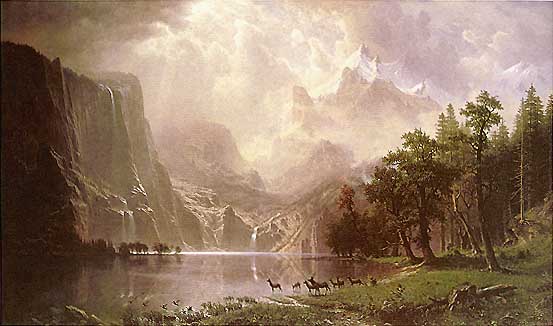
Albert Bierstadt, "The Sierra Nevada In California"
Department of History, Philosophy, Religion, and Social Sciences
Choate Rosemary Hall
Wallingford, Connecticut
History 310
UNITED STATES HISTORY
Hypertext Course Syllabus, Part II
Winter 2007–2008 term
| TABLE OF CONTENTS Goals of the Course Daily Preparation Classroom Work Written Work Texts and Course Materials Program and Workload Schedule of Meetings and Assignments |
Contact Information |
Albert Bierstadt, "The Sierra Nevada In California"
"Each age will re-write the history of the
past anew . . ."
- Frederick Jackson Turner
These texts for the course—available at the school bookstore—should be purchased by all students immediately:
This course will be orthodox in its presentation: in general, you'll read something before each class meeting, and in class we'll discuss what you've read—what I call "Socratic discussion." You'll be expected to write short yet demanding papers, take period tests and a departmental final examination, and participate regularly in class.
Every effort has been made to keep the length of daily assignments manageable. Many worthwhile assignments were abbreviated or scrapped from the syllabus altogether. It's important, therefore, that you commit yourself now to keeping up with what is included among the assignments below; you'll be expected to complete the assigned homework before each class.
What follows is what we'll try to cover during the term. It may be adjusted from time to time for any number of reasons. The homework for the next class is always the next assignment unless you are told differently. You'll find each entry on the schedule below contains some instructive questions and ideas you should consider in preparing for class; get into the habit reading the syllabus carefully each night as you begin your homework.
Schedule of Meetings and Assignments
U.S. HISTORY, PART II: "The Pursuit of Prosperity: Winners and Losers"
The goals of the second part of this course are essentially twofold: (1) to continue building survey knowledge of the history of the Republic from the mid-1800s through the early twentieth century; and (2) to explore a thematic understanding of this period in U.S. history as the pursuit of prosperity; we will be particularly interested in winners and losers in an America undergoing remarkable expansion—demographic, territorial, and economic. We will examine several focal points in Part II of the course: (a) the American West in history and mythology, including the Native Americans; (b) industrialization and urbanization; (c) the social and political reform movements called Populism and Progressivism; and (d) American life in the Jazz Age—the 1920s—and in the Great Depression that followed. We'll save our discussion of foreign policy issues in this period (e.g., the Spanish-American War and World War I) for Part III of the course.
53. The Forgotten Presidents and the Gilded Age.
Read B&K, pp. 501–526. As you should have realized by now, we are using Volume II of B&K. Analyze Grant's performance as president. How could such a great general be such a poor political leader? What were the great economic issues of the day? The political ones? What was the Ku Klux Klan? Be prepared to justify its existence, and to condemn it. Recall Gone with the Wind for ideas. Four-minute oral report on the compromise of 1877 by ________________ . (See Randall and Donald, Civil War and Reconstruction and Woodward, Reunion and Reconstruction, both in the Mellon Library.)
FOCAL POINT: Industrialization and Its Social Impact
Again, this topic explores issues that still beset America. In fact, in an age like ours where political and economic leaders disagree on where the future should take us, industrialization might be the most important historical issue of all time. Here we will study its origins and early years in America. You should master the following: (a) conservative ideologies such as laissez-faire, gospel of wealth, and social Darwinism; (b) the technology of the new enterprise; (c) the entrepreneurs, and whether they were "robber barons" or industrial statesmen; (d) the benefits and liabilities of urbanization; and (e) the dissident voices and the growth of social consciousness.
54. Analysis of the Problem.
Read Sigmund Diamond, "The Impact of Industrialization On American Society" u including the accompanying documents. Note that we are reading an interpretive overview first; some of the data may be strange right now, but you'll read more about it later. Try to understand the fantastic changes that were going on. What were the major concerns of the tycoons? How did they cope with them? How did they justify their own actions? Were they correct in their analyses and their policies?
55. The Working Class.
Read Herbert G. Gutman, "Labor's Response to Modern Industrialism" u including the accompanying documents. Again, we will explore the data later. The BLS of Massachusetts asks the central question. Find it, study it, and provide your own answer. You'll be required to support your reply.
56. Some Data.
Read B&K, pp. 446–447 and 528–552. Note how much easier it is to read about things when you've already read about them once. Just more proof of the theory that you learn history best by multiple readings. Why do we start with the Civil War things? Distinguish between Carnegie's and Rockefeller's approaches to consolidation. Why were railroads, steel, and oil the "big three"? What did the unions achieve?
57. Urbanizing America.
Read B&K, pp. 554–584. What connections are there between industrialization and urbanization? What is it about urban life that seems to engender reformism? (Remember the 1830s.) With which of the reformers mentioned do you most sympathize? Why were there so many women involved in the movements? Did "corrupt" city political machines do any good? Is it possible that they were mostly good?
58. Industrial Statesmen or Robber Barons?
All read pp. 3–4 from Conflict and Consensus u, then odd numbers read Josephson's essay on pp. 16–33 and even numbers read Nevins' essay on pp. 34–43. Prepare to defend the point of view presented in the essay you read. The two authors do not agree.
59. Immigrants.
Assignments in Packard, Fires of God u. Odd numbers read pp. 115–118 and 145–156. Evens read pp. 119–132 and 133–144. All read pp. 157–164. Make a matrix chart for the groups of the immigrants that you study, showing why they came, where they settled, what their most severe problems were, what ironies there were in their settlement, how they coped, who their leaders were and what they did, whether they are now assimilated, and, if so or if not, why?
60. Period Test #4.
Covering all material studied since the last period test, and reaching back before then more generally.
61. First Americans.
Read Packard, Fires of God, pp. 3–20 u. Try to find the one thing that was the irreconcilable rub between the "Anglos" and the Native Americans, and then pursue it throughout the reading. Be able to distinguish among the various Indian programs mentioned, as well. Buy Hofstadter, The Age of Reform at the school store.
62. End of the Frontier.
Read B&K, pp. 586–602. By what means did the whites defeat the Native Americans? Might the Indians have prevailed by acting differently? If so, what kept them from doing so? What did the whites seek in the West? What did they find? Where? When? Study the relationship between the railroad and the West. Did the railroad do any good? Any evil? Be specific.
63. The Mythologized West.
art
64. Populism I.
Read B&K, pp. 602–619. Be sure you understand the relationship between government and industry. This is that elusive third element of Reconstruction referred to a while ago. What role did the Courts play? What, if any, were the differences between the Republicans and the Democrats in this era?
65. Populism II.
Read B&K, pp. 619–626 and "The Omaha Platform"; u. What were the farmers' grievances? How did they express them? Read the Omaha Platform very carefully, and make groups of its political, economic and social planks. How much of it was realistic? Diagram in your notes the relationships among the Grange, the Alliances, and the Populist Party. Who belonged to which group? How did the silver issue become part of the Populist cause? If you can, bring a dollar bill, a silver coin, or a gold coin to class. Know the important people: Bryan, Coxey, Donnelly, Harvey, Tillman, Watson, Weaver.
66. Agrarian Myth?
Read Hofstadter, The Age of Reform, ch. I, sections I and II. What is the theme of this reading? Was Hofstadter a "friend" of the farmers or not? (For his answer, see pp. 12–13.) What is his analysis of why the farmers could not correctly perceive their own situation?
67. Realistic Dissent?
Read Saloutos, "Populism Reexamined" u including the accompanying documents. What is the theme of this essay? Do the documents support the analysis? Would Hofstadter have agreed with Saloutos?
68. Progressivism I.
Read Hofstadter, The Age of Reform, ch. IV, sections I and II. How did the Mugwumps become important and why? When? What is meant by status anxiety? Were the progressives liberal or something else? What is a liberal?
69. Progressivism II.
Read B&K, pp. 667–688. Many people see these reforms as liberal; is that a correct view to take? Or was the movement much more complex? Notice the breadth of the movement. Was Teddy Roosevelt a progressive? If so, how? The TR/Taft split had effects that continue to affect the Republican Party today; can you identify them?
70. Progressivism III.
Read B&K, pp. 690–698. For the 1912 campaign, distinguish among Roosevelt's "New Nationalism," Wilson's "New Freedom," and Taft's nameless progressivism. Was Wilson true to his own platform once in office? Get the data on the tariff, the Federal Reserve, the FTC, and the Clayton Act.
71. Period Test #5.
Covering all material studied since the last period test, and reaching back before then more generally.
72–75. Independent Study Unit on the Jazz Age.
Instructions are available here.
76. New Deal I.
Read B&K, pp. 784–802. How did FDR's view of the Depression differ from Hoover's? What is meant by relief, recovery, and reform. Give examples of programs that fit into each category. In the next few days, make charts of the various New Deal programs and agencies, under the following headings: name, date passed, person in charge, goal, method, reasons for success/failure. Period test at #97, below.
77. New Deal II.
Read B&K, pp. 802–812. What groups comprised FDR's political coalition? Why? What groups opposed the New Deal? Why? What influence did political pressure have on the shape of the New Deal programs? Was FDR's foreign policy anything like his domestic policies?
78. New Deal III.
Odd numbers read Albertson, "The New Deal" u; evens read Degler, "The Third American Revolution" u. Could FDR have sought Marxist or fascist solutions to the problems of American capitalism? Was the New Deal progressive by Hofstadter's definitions? Why does Degler call it a "revolution"? Note his anecdotes. What made the New Deal labor laws work when earlier ones like the Clayton Act of 1914 had not? Be able to describe and support or refute Galbraith's idea of "countervailing power."
79. Winter Term Final Examination.
A departmental examination will be scheduled during the exam period in early March. Stay tuned for details. Read "Preparing for Your Final Examination" and "How to Prepare for an Examination Essay." Ask me in class about review session details.

This syllabus copyright © 1987-2008 Ned Gallagher. All rights reserved.
Last revised:
September 7, 2007